Live Art Writers Network x Dias da Dança Festival – DDD 2026
Working with the Encruzilhada (the crossroad) as a space for non-linear thinking, divergent methods and entangled research (learning alongside texts such as Pedagogia das Encruzilhadas by Luiz Rufino), this year’s Live Art Writers Network (LAWN) at Festival Dias da Dança Festival (DDD) 2026 responds to contexts that let things grow, conditions for contradiction and what it means for cultural spaces to catalyse the creation of both centre and periphery. The programme consists of texts, conversations, events and a residency within the DDD archive, co-curated in collaboration with Pedro Vilela.
“There is a city built upon a rock so hard that no one has ever managed to put down roots there without first asking permission.”
– from Pedro’s text | “Let us cultivate the forest II: The persistence to blossom”
In our time inhabiting the festival, our collaborators have shaped a multi-vocal response to an emerging urgency: to think through Porto’s creative ecology and the future of a city that is struggling to sustain spaces for encounter, critical thinking, and creative work. These spaces are increasingly under threat from the privatisation of life, as tourism, gentrification, and a conservative political landscape reshape and gradually hollow out the city from within. How our work as artists, programmers and performers responds to this feels important, as many of our collaborators are fighting for a critical ecology of thought and practice that is able to think through possible responses in the face of these systems that increasingly feed on the city (and people) they depend upon. The responses generated through this year’s programme critically reflect on the infrastructure of a cultural sector that has held DDD for over 10 years, situating it as a site that reflects so much about what has changed and what has remained the same in the city of Porto.
“bury it bury it, my dear,
bury the dream here in our soil, for
it will be fertile and
you’re biting the hand that feeds you”
– from Odete’s text
There is a need to cultivate an ecology of autonomy and build a capacity to connect what’s happening in our creative work to what is happening to the city (Porto and beyond): to the people and places who, like us, are feeling the suffocating impact of conditions that impact us all whether we are migrants, working class people, queer folks or just someone trying to make life bearable. Connecting to these contexts goes beyond an impulse to perform ‘inclusion’, it is something we must consider as cultural workers if we want to till the soil that our dreams grow in, it is a necessary complicity to nourish any kind of collective freedom in the face of what is already conditioning our work and our lives. As Tiziano Cruz said in our conversation, we must ask whether we are complicit in the generation of the margins, ask ourselves if we are re-sedimenting the centre. How are we being pushed to the periphery and who are we pushing in turn? How can we meaningfully engage with how our work, our identities, our stories and our experiences are being used, circulated and also co-opted as a part of this? Is this process life-affirming or is it driving us deeper into knots and contradictions? Where should we go at this crossroad?
There is no single answer to this question, but here are many attempts at trying to re-imagine possible reflections. Never conclusive or closed, in this year’s LAWN programme, critical thought engages with what we produce and with the complicated conditions that allow us to do it. Critical writing is not just a recounting of what happened, not just an opportunity to complain (although we do this too), it is a chance to think reflexively in a way that opens more questions that bring us closer to interrupting how we might engage with inherited infrastructures of power that shape our work as artists, thinkers, researchers and audiences.
DDD x LAWN Critical Commissions
All texts are available in Portuguese and Spanish, with translation into English by performingborders.
Working directly in dialogue with Black women living in Porto, Claire Sivier’s text unfolds through a series of collaborative critical reflections that depart from performances at DDD. Written alongside invited guests, the text reflects on gendered and racialised experiences of the city and its cultural spaces, thinking with Katherine McKittrick’s Demonic Grounds: Black Women and the Cartographies of Struggle to trace how these experiences are lived, navigated, and resisted through performance, conversation and friendship.

Feeling Our Way Through: Between Recognition and Distance | Claire Sivier (text + audio)
Sentindo o Caminho: Entre o Reconhecimento e a Distância | Claire Sivier
Hilda de Paulo’s reflection takes the infrastructures of representation as a central concern in her critical response to Porto’s cultural ecology. Thinking beyond what it means to make space for trans voices, the text attends to what happens when these experiences and practices are not met with material and economic support. In doing so, this critical reflection engages with what processes of representation do, beyond symbolic gestures of inclusion, thinking towards how we can work with dissent, transfeminist works and artists.
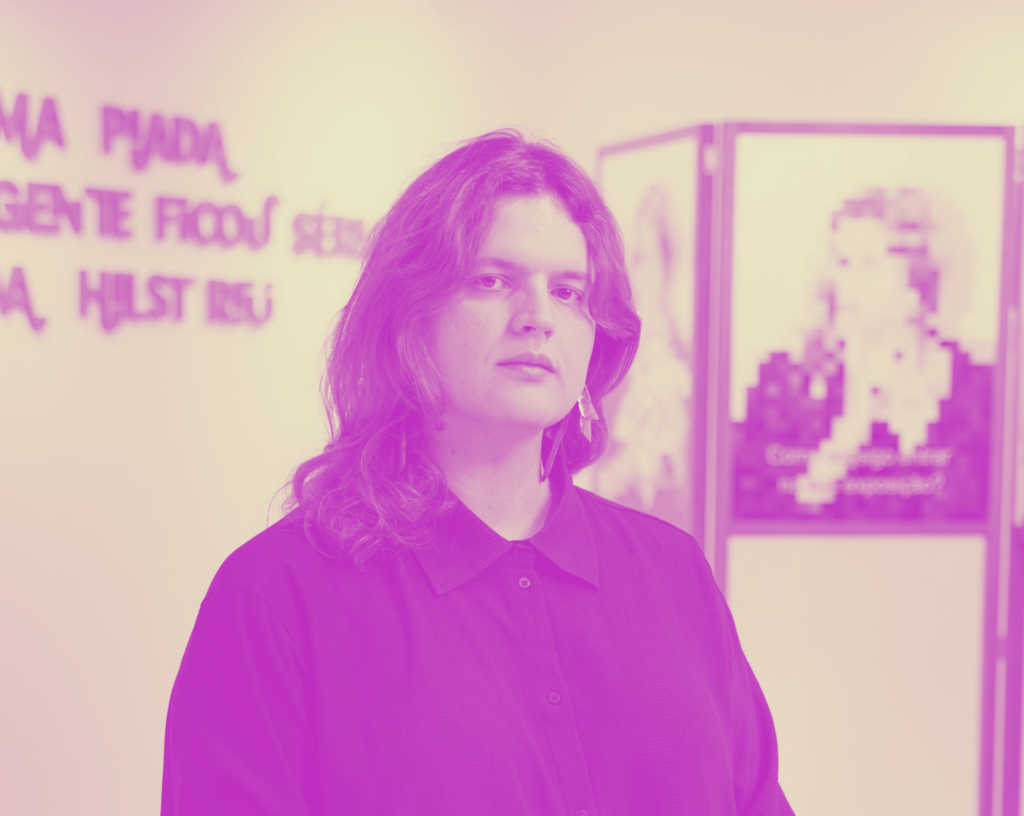
“WHO PROFITS FROM TRANS* LIVES?”: ON ECONOMIC REDISTRIBUTION AND TRANSGENDER ETHICS | Hilda de Paulo
“QUEM LUCRA COM AS VIDAS TRANS*?”: SOBRE REDISTRIBUIÇÃO ECÔNOMICA E ÉTICA TRAVESTI | Hilda de Paulo (text + audio)
We documented our conversations as a part of the DDD public programme including reflections on the laboratory “Archiving, writing and performance as practices of reflexion and critique” (CAMPUS, 11 April 2026) by Xavier de Sousa, alongside three new texts and interventions by Pedro Vilela, Dori Nigro and Tiziano Cruz following our conversation “These bodies in this city: situated landscapes in performance and critical writing”(A PiSCiNA, 13 April 2026).
These bodies in this city – a reflection on disquiet memories | Portuguese and English
Xavier de Sousa


Constructing centres and peripheries: Art practices for social transformation | English
Construyendo centros y periferias: prácticas artísticas para la transformación social | Spanish (text + audio)
Tiziano Cruz
Reverberations and Reparations | English
Reverberações e Reparações | Portuguese (text + audio)
Dori Nigro

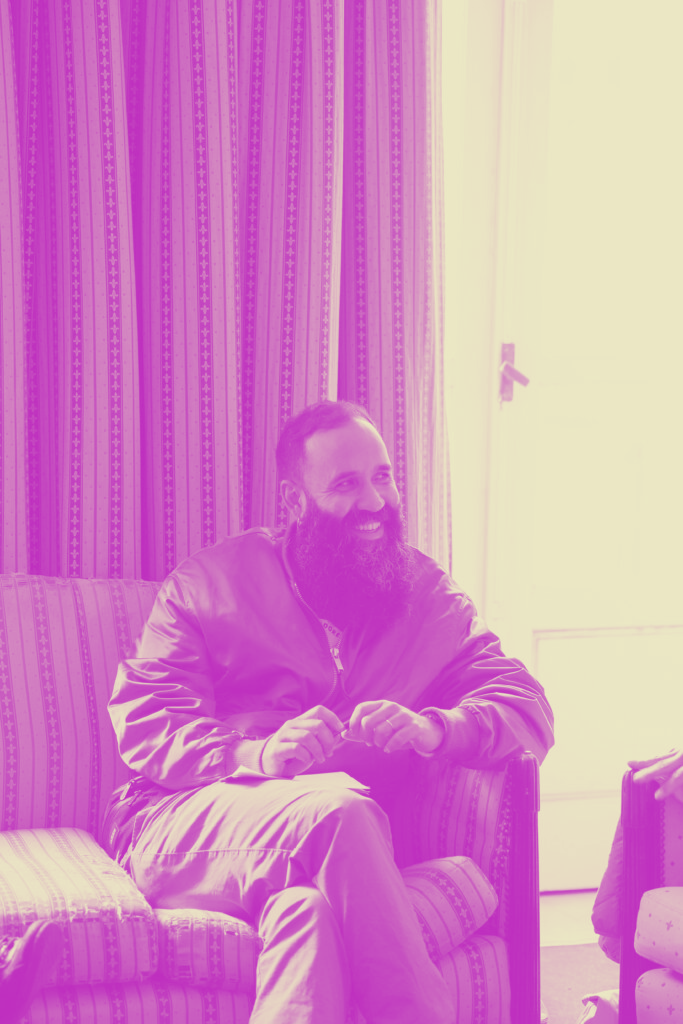
These bodies, in this city: territory, performance, and critical writing | English
Estes corpos, nesta cidade: território, performance e escrita crítica | Portuguese (text + audio)
Pedro Vilela
The residency in the DDD archive produced a series of conversations, reflections and texts drawing out histories and narratives from the festival’s trajectory, and the multiple ways it has been enmeshed in, shaped by, and experienced within the city of Porto. This is gathered across performingborders and the DDD blog. Featuring contributions from Pedro Vilela, Dori Nigro, Odete and Teresa Fabião.
- Encruzilhada: performingborders at the crossroads of DDD | performingbroders & Pedro Vilela (ENG and PT)
- Odete | Odete (ENG and PT)
- Let us cultivate the forest II: The persistence to blossom | Pedro Vilela (ENG and PT)
- Conversation about conversations: have we already discussed everything there is to discuss?… | Dori Nigro, Pedro Vilela, Teresa Fabião and Xavier de Sousa (ENG and PT)
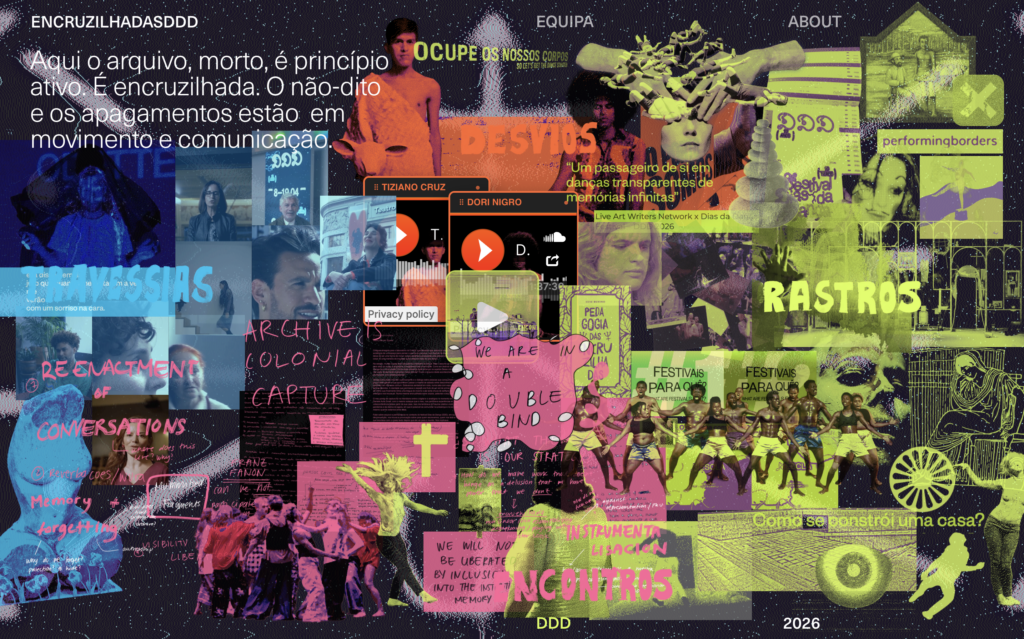
As a conclusion to this residency, we have commissioned artist and web designer Thiago Liberdade to create a digital exhibition space bringing together all of this material, plus historical critical texts and documentation, in the form of a digital encruzilhada, a space that refracts, remixes and connects the material gathered throughout our programme at DDD and residency at CAMPUS, making material the methods we’ve used to arrive at our many reflections. This space will be live for one year, extending our residency into a digital exhibition until May 2027.
Live Art Writers Network at DDD 2025 is a co-production between performingborders and Festival Dias da Dança – DDD 2026, in partnership with CAMPUS Paulo Cunha e Silva. Co-funded by Necessity.
Pedro Vilela is an artist-curator-researcher. He is a PhD candidate in Art Education at the Faculty of Fine Arts of Porto, where he is developing TREMA!, an association that through art connects Brazil and Portugal, and collaborates with different organizations in the city of Porto. His central interest lies in the Afro–Latin American scene, engaging with themes such as decoloniality and mechanisms of racialization. He is the first Latin American to receive the Magaly Muguercia Grant, promoted by the Iberescena Programme.
Hilda de Paulo (Inhumas-GO, Brazil, 1987) is an artist, independent curator, researcher, and writer. She develops a transfeminist and transdisciplinary artistic practice that moves between painting, sculpture, performance, writing, and critical pedagogy, addressing themes such as gender dissidence, decolonial perspectives, and belonging. She is a PhD candidate in Literary, Cultural, and Interartistic Studies at the Faculty of Arts and Humanities of the University of Porto (Portugal). She is the author of the project Arquivo Gis and a founding member of Cia. Excessos and the e-journal Performatus.
Claire Sivier (she/her) is a Black-British social researcher, cultural producer and facilitator living in Porto. Over the last 15 years her work has been developed with artists, young people and those from marginalized communities, as well as delivering a range of festivals and cultural programmes. In 2020 Claire completed a masters degree in Art & Design for the Public Space at Belas Artes Faculty, Porto where she developed a walking art methodology exploring the lived experiences of black female diasporic artists in Porto. She has since founded Caminhada de Mulheres Negras (2021) as a space for black women and no-binary people to connect and walk in nature. Claire is the co-director and co-founder of There is an Alternative, an arts-based research social enterprise. As a walking artist she is interested in the intersections of the black queer experience, ecology, rituals, and unlearning. She is also a member of the InterStruct Collective; a network of researchers and artists working across socially engaged projects and decolonial practice based in Portugal and across Europe.
Daniele Avila Small (Rio de Janeiro, 1976) is a theatre maker, critic, and curator. She is currently a collaborating professor of the Graduate Programme in Performing Arts at UNIRIO. Since 2023, she has been dedicated to developing the art-research project The Endless Museum of 1976 and collaborates with the platform Trilhas da Cena. Among her most notable work is Há mais futuro que passado – Um documentário de ficção (There Is More Future Than Past – A Fictional Documentary), which premiered in 2017 and toured until 2022. She has published plays with the publishers Cobogó and Javali. She is the founder of the magazine Questão de Crítica, which she edited from its creation in 2008 until its closure in 2024. She is also the author of the book O crítico ignorante – Uma negociação teórica meio complicada (The Ignorant Critic – A Rather Complicated Theoretical Negotiation, 7Letras, 2015).
She is currently a member of the jury for the Shell Theatre Prize. Her experience in programming and curating began with the Ocupação Complexo Duplo at Teatro Gláucio Gill in 2011 (nominated for the Shell and APTR awards). She has been part of curatorial teams for festivals and reflective programmes, such as Olhares Críticos at MITsp between 2018 and 2020. She is one of the creators of the Movimentos de Solo programme by Complexo Sul. She is currently the research and curatorial coordinator of the project Theatre and Brazilian Democracy.
Dori Nigro is a creator, performer, art educator, and researcher, affiliated with the Faculty of Fine Arts at the University of Porto and the College of Arts at the University of Coimbra. Since 2007, he has been dedicated to interdisciplinary artistic practices. He holds a PhD, a Master’s degree, and a postgraduate specialisation in the fields of contemporary art, artistic practices, and art/education. He also holds a degree in Pedagogy and a bachelor’s degree in Social Communication/Photography.
He lives and works between Portugal and Brazil, facilitating collaborative activities with artists and local communities. Together with Paulo Pinto, he cares for LÁRoyé, a house/studio for affective, creative, and ancestral exchanges, where they develop research and creative work within artistic practice and art/education. He is a member of União Negra das Artes (UNA).
Tiziano Cruz is an interdisciplinary artist whose work fundamentally integrates visual and theatrical language, performance, and artistic interventions in public space. Tiziano has been a fellow of the National Arts Fund and the National Theatre Institute of Argentina (INT-ARG). He was the winner of the 2019 Young Art Biennial, the ANTI Prize in Finland in 2023, and in 2024 received the “ZKB Audience Prize 2024” at Zürcher Theater Spektakel in Switzerland. He is the founder of the cultural management platform ULMUS, dedicated to mediating between different cultural organizations in Argentina and neighboring countries. He has worked as a content producer at the Recoleta Cultural Center in Buenos Aires. His work has been presented in Chile, Brazil, Mexico, France, Canada, Portugal, Spain, Switzerland, Germany, Finland, Italy, Poland, Turkey, the United Kingdom, and the United States.
Tiziano’s participation is made possible through the Fragmented Cities residency cycle, a program of architecture, research, and art by the studio Frame Colectivo, which investigates forms of socio-spatial segregation in the Lisbon metropolitan area and the practices of resistance that emerge from peripheral territories. The program will take place in 2026 at the c/arpa space in Lisbon. As part of the residency, Tiziano Cruz will present public performances of his work on April 9 and 16 in Lisbon, and on April 13 in Porto.