“WHO PROFITS FROM TRANS* LIVES?”: ON ECONOMIC REDISTRIBUTION AND TRANSGENDER ETHICS | Hilda de Paulo
22nd May 2026This text was commissioned as part of Live Art Writers Network x Dias da Dança Festival 2026. For more information on the festival and the work done while in residency, alongside other commissions, visit this page.
Read text in Portuguese: “QUEM LUCRA COM AS VIDAS TRANS*?”: SOBRE REDISTRIBUIÇÃO ECÔNOMICA E ÉTICA TRAVESTI
“People think that what is different is grotesque and monstrous; I was hated so much that I have good reasons to write. I was never a source of hope for anyone. I string words together and write mediocrely about this emptiness. I write because I am not the only one. My transvestite friends and I are rejected because the body is sacred and one does not play with it. That is why I write—for all the transvestites who never realized they were alive, for the guilt and shame of not having bodies worthy of love, and who died young before they could be happy. They died without having written even a single love letter.”
Based on this excerpt (1), the Chilean author Claudia Rodríguez, “the trans daughter of generations of illiterate mothers” (2), understands writing as an act of inscription in the face of historically marginalized experiences. In this context, testimony ceases to be merely an individual expression and becomes a practice of collective enunciation, anchored in situated material conditions. In this way, writing functions as a device for producing intelligibility through which certain subjects take the floor and inscribe their modes of existence in the realm of the visible and the sayable.
It is within this framework that the use of situated accounts as part of the analytical process itself is justified. At certain points, I draw on experiences I have had firsthand, as well as those narrated by others, given the difficulty of conceptualizing transfeminism, as well as other forms of feminism, when they are dissociated from the ways of life, life trajectories, and concrete conditions that shape women’s experiences. There is no universal subject capable of encompassing such plurality; on the contrary, insisting on this notion contributes to the erasure of the differences that structure these lives.
In this sense, it is the ways of life embedded in the world, especially those marked by multiple forms of violence and by mechanisms for regulating bodies, that allow us to situate such existences within their contexts and recognize their political dimension. It is through this process that meanings are produced and the significance of these experiences becomes apparent. For this reason, these trajectories are not merely illustrative examples, but rather constitutive elements in the development of a transfeminist theoretical framework.
It is precisely within this framework that we examine specific works that bring together lived experience, the circulation of images, and the symbolic economy. With this in mind, I present a few examples that illustrate how such conflicts manifest themselves in the visual realm as well.
I write this text drawing on my experience as a trans and migrant artist radicated in Portugal, embedded in the artistic ecosystem of the city of Porto and navigating institutional circuits that, in recent years, have increasingly incorporated dissident bodies and productions into their programs, festivals, and exhibitions. However, this increased visibility does not necessarily imply structural transformation. In many cases, the trans presence is incorporated as a contemporary sign of diversity without this leading to economic redistribution, institutional permanence, or an effective alteration of the hierarchies that organize the cultural field. In this context, I am interested in considering how certain experiences are mobilized, legitimized, and converted into symbolic value, while simultaneously remaining subject to precarious conditions of circulation and recognition.
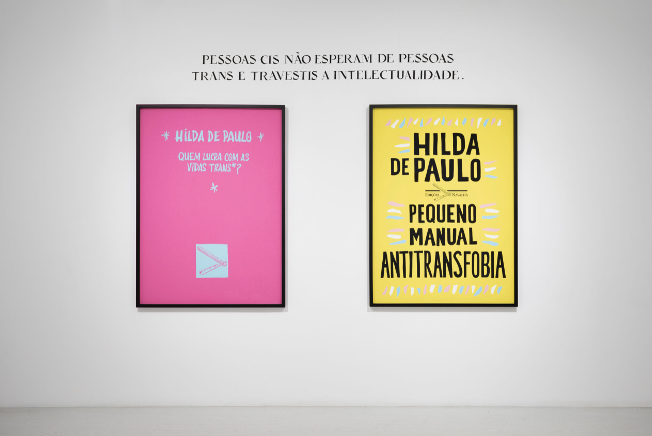
On September 20, 2023, I received an anonymous message via Instagram regarding the poster Who profits from trans* lives?: “Hello, Hilda. I was confused, but I imagine the answer lies in the book itself. Why did you use the cover [of the Portuguese edition] of As malditas, by Ana Jotta, as a reference in your poster?” The choice to subvert this cover, designed by the Portuguese artist – herself cisgender -and marked by the recurring use of the colors blue and pink associated with the trans flag, constitutes a deliberate shift of attention toward the material conditions that enable the circulation of trans people and transvestites in the arts. By re-inscribing this image as a poster, I seek to create tension within the circuit through which it is translated and distributed as value within the Portuguese art world.
Far from being an isolated case, this episode is part of a broader set of questions regarding the visibility, legitimacy, and circulation of dissident works. Along the same lines, another instance allows us to explore this issue in greater depth within a different context.
Months earlier, on May 17, 2023, during the online class Transfeminist Knowledge in Aesthetic Propositions, taught as part of the course Artistic Practices and Contemporary Epistemes: Fundamental Debates, organized by Assemblage, I was asked by a student about the future of so-called “new forms of identity inclusion” in the arts. The question demanded a situated response. In answering it from the Portuguese context, I pointed out that inclusion, in this scenario, presents itself in a residual, concentrated, and often ephemeral manner. This thus constitutes a regime of visibility in which dissident presence is produced in a sanitized manner, while processes of legitimation remain anchored in white, cisgender, patriarchal, and national political structures, organized according to a colonial matrix that is rarely problematized.
This framework can be understood through the interplay between image and power. As the American theorist bell hooks argues, visual politics is not merely about what is seen, but involves “the way race, gender, and class shape artistic practices [that determine] who makes art, how it is sold, who validates it, and who writes about it” (3). Within this framework, visibility can function both as a vector of transformation and as a mechanism of regulation. Difference can become perceptible, but only under strictly controlled conditions.
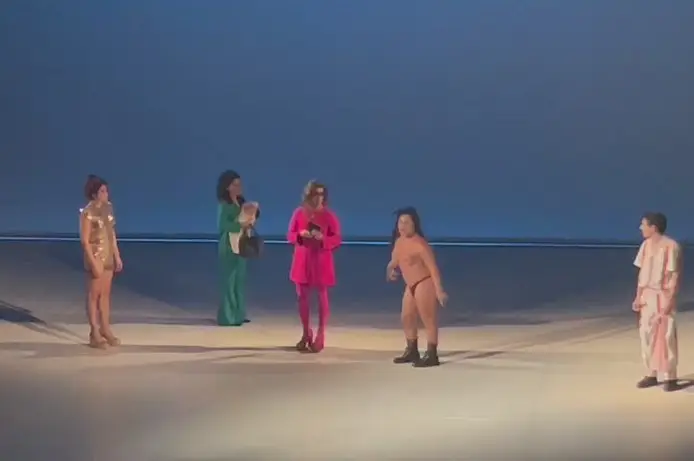
This issue takes on greater significance when considered in light of the epistemic rupture caused by the Brazilian transvestite actress and sex worker Keyla Brasil in response to the casting of the cisgender Portuguese actor André Patrício to play the trans character Lola in the play All About My Mother in January 2023. By highlighting the disconnect between representation and lived experience, Keyla exposes the limits of an inclusion that takes place in the realm of fiction, while the concrete conditions of existence remain unchanged. In this context, presence is authorized as an image, provided it does not destabilize the structures that regulate it.
This logic is not limited to the realm of fictional representation; it is also evident in the concrete conditions governing circulation and presence within cultural spaces.
On March 13, 2026, I learned of the incident involving the Brazilian author Leda Maria Martins from an account given by the Brazilian curator Pedro Vilela (4):
“Following the opening conference of Quilombo_Trema! in 2023 at the Municipal Theater of Porto, researcher Leda Maria Martins—a leading figure in Brazilian Black theater—began a book-signing session for an audience that was predominantly Black. During the event, the stage lights were simply turned off. More than a technical gesture, it came across as a sign of interruption—almost of expulsion. Faced with the situation, Leda proposed continuing at the theater’s entrance. And it was there, on the sidewalk, taking advantage of a lull in the rain, that the event continued. The episode is neither isolated nor innocent. It highlights how certain bodies continue to be tolerated only up to a certain limit. Beyond that, they become surplus.”
This account resonated directly with my own experience. Seven days earlier, during the launch of my book Hilda de Paulo #01 (2023) at the same theater, then under the artistic direction of Portuguese programmer Cristina Planas Leitão and North American performance curator Drew Klein, I was prevented from selling the publication inside the venue because I did not meet the requirements for a legal entity. This was in contrast to what happened in 2016, when I presented, at that same theater, then under the direction of Portuguese programmer Tiago Guedes, the book Quinze anos de minha vida, by American dancer Loïe Fuller, which I had edited.
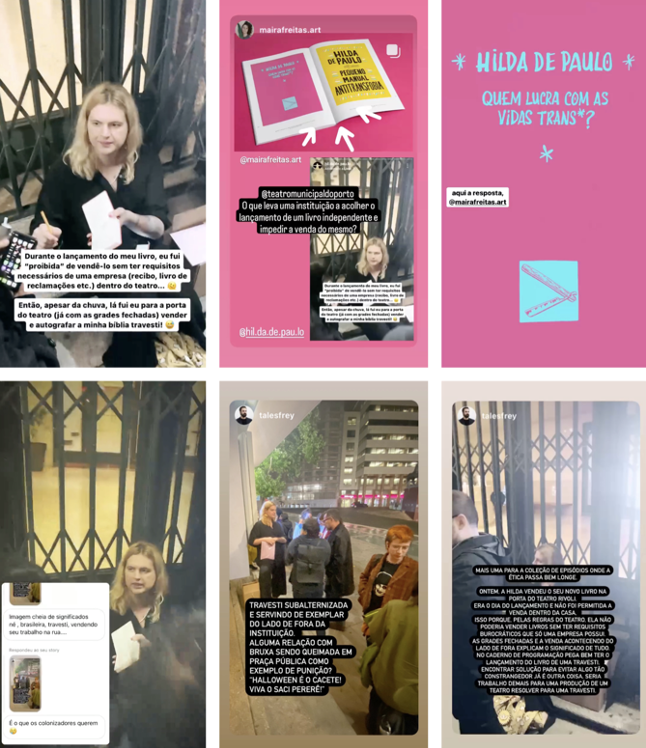
In the most recent instance, I stood on the steps leading up to the Rivoli Theater, selling and signing copies as the gates closed, the lights went out, and the rain fell. This is no coincidence, but rather the repetition of a pattern that determines who is allowed to stay inside and under what conditions.
It is within this context, marked by the concrete limits of permanence, that the questions posed in “Scene Four: Heart on the Tip of the Tongue,” from the 2022 lecture-performance-workshop What Comes After Hope?, take shape. More than a rhetorical device, these questions function as a diagnosis of structural inequalities in access to work, income, and social participation, by shifting the reflection to the materiality of the conditions of existence:
Here in Porto, how many TRANS* people or drag queens have served you at Farmácia Barreiros? Or at the Pingo Doce supermarket on Passos Manuel street? At Confeitaria do Bolhão? How many times have you gone to Santo António Hospital and the doctor was a transvestite? And how many TRANS* lawyers have you met? How many TRANS* politicians are there in your favorite political party? How many TRANS* people and transvestites have you had a romantic relationship with? In your family, if a child had a story similar to the ones we just told, how did your relatives react? And you? And on stage, at the São João National Theater, how many times have you seen us? And if you did, what was the play about? Genitalia? Transformation? The so-called transition (when does it begin? when does it end?). Was it exotic, comical? Was it sexual? Tragic? (5)
From this perspective, As malditas by Camila Sosa Villada, published in Portugal, serves as a particularly illuminating case. The questions raised above allow us to shift the analysis from the strictly aesthetic dimension to the structural conditions that underpin its circulation. When considering the different stages involved – such as production, translation, design, printing, distribution, and marketing – a central question arises regarding the symbolic economic appropriation of this process, incisively reframing the question that guides this text: that is, who, after all, profits from trans* lives?
In this case, this shift makes it clear that the circulation of the work is not limited to the dissemination of a trans experience, but involves its integration into a value chain in which most of the benefits accrue to cisgender agents responsible for its legitimization and distribution. It is, therefore, a process in which visibility does not necessarily translate into economic and symbolic redistribution, but may, on the contrary, reinforce existing asymmetries. As bell hooks observes, even critical practices originating from marginalized subjects can be incorporated by dominant structures, such that “we run the risk of seeing our ideas appropriated or of not being recognized by those who enjoy more power, more authority, within the existing structure” (6). In this sense, a dissident presence may be admitted within these circuits as long as it does not destabilize the value systems that sustain their own marginalization.
It is precisely based on this logic, in which visibility does not imply material transformation, that this perspective shifts the debate toward the realm of economic redistribution, as I noted in my appearance on the podcast A beleza das pequenas coisas (The Beauty of Small Things), produced by the newspaper Expresso, in 2022. One observes, then, a dissociation between symbolic presence and material remuneration, since difference circulates as an image but does not translate into the redistribution of resources. For example, the controversy surrounding the translation of the work by the Black American poet Amanda Gorman in the Netherlands in 2021, initially attributed to the white Dutch writer Marieke Lucas Rijneveld, highlights the potential to bring these asymmetries into sharp relief. The translator’s refusal, in the face of public debate, can be understood as a gesture that reopens the question of economic redistribution, by shifting the focus from representation to the material conditions of access and participation in processes of cultural production. In this context, it becomes necessary to recognize the limits of one’s own presence and the importance of ethical strategies of refusal as a means of redistributing positions and functions within these circuits. Thus, such practices point to the possibility of reconfiguring this system by directly intervening in the unequal conditions of access and participation. As bell hooks states, we must “constantly confront this art world rooted in a patriarchal, capitalist, and white supremacist politics of exclusion, where our relationship with art and aesthetics can be overwhelmed by the effort to challenge and change this structure.” (7)
Returning to this debate, the publication of As malditas in Portugal thus raises another question. Is this an initiative aimed at expanding access for transgender and transvestite people to literary works by dissident authors, or is it an endeavor driven by the contemporary commodification of these experiences for consumption by predominantly cisgender audiences, supported by international recognition and the market value of the work? Considering the economic inequalities that affect this population, this distinction becomes even more crucial, as it highlights that those who most need this access are often those who are least able to obtain it. Thus, the circulation of knowledge proves inseparable from dynamics of value, legitimacy, and economic interest, bringing back, in concrete terms, the issue of economic redistribution that runs through this writing.
Given this scenario, it becomes necessary to reframe the issue in material terms. How can we produce trans and transvestite epistemologies rooted in local experiences and sustained by concrete conditions of existence? How can we ensure that the production of knowledge transcends the symbolic dimension and leads to an effective redistribution of resources? How can we disrupt a logic that transforms lives into value without an equivalent return? It is within this framework that I situate my work in Portugal, not merely as a critical examination of forms of representation, but as an intervention in the conditions that structure cultural production. It involves operating in the field of the image without dissociating it from the economic dynamics that sustain it, affirming a practice that is not limited to visibility, but that challenges economic redistribution, permanence, and conditions of existence.
“WHO PROFITS FROM TRANS* LIVES?”: ON ECONOMIC REDISTRIBUTION AND ETHICS TRAVESTI is a commission by performingborders and the Dias da Dança Festival (DDD 2026) for the Live Art Writers Network.
Hilda de Paulo (Inhumas-GO, Brasil, 1987) is an artist, independent curator, researcher, and writer. She pursues a transfeminist and transdisciplinary artistic practice that spans painting, sculpture, performance, writing, and critical pedagogy, addressing themes such as gender dissidence, decolonial perspectives, and belonging. A doctoral candidate in Literary, Cultural, and Interartistic Studies at the Faculty of Arts of the University of Porto (Portugal), she holds a bachelor’s degree in Art History, a master’s degree in Fine Arts/Sculpture, and a specialization in Contemporary Artistic Practices, all from the same institution. She is the creator of the Arquivo Gis project and a founding member of Cia. Excessos and the eRevista Performatus.
Among her recent solo exhibitions, the following stand out: “Where My Feet Tread” (Soares dos Reis National Museum, Porto, Portugal, 2026); “How Are You, Mr. Curator?” (Retina Gallery, São Paulo, Brazil, 2025); and “Transvestite Heart” (KUBIKULO Project, Kubikgallery, Porto, Portugal, 2022). Recent group exhibitions include: “Tropical Delirium” (3rd SOLAR Fotofestival, Pinacoteca do Ceará, Fortaleza, Ceará, Brazil, 2024); “Space for the Body: Works from the Serralves Collection” (Casa Branca de Gramido, Gondomar, Portugal, 2024), “Leiðnivír | Conducting Wire” (Akureyri Art Museum, Akureyri, Iceland, 2023), “Zil, Zil, Zil” (Hélio Oiticica Municipal Art Center, Rio de Janeiro, RJ, Brazil, 2022) and “Error 417: Failed Expectation” (Porto Municipal Gallery, Porto, Portugal, 2021).
Some of her works are permanently part of the collections of institutions such as the Akureyri Art Museum (Akureyri, Iceland), the Serralves Foundation (Porto, Portugal), the Municipal Art Collection of the City of Porto (Portugal), the Cerveira Art Biennial Foundation (Vila Nova de Cerveira, Portugal), the Goiânia Art Museum (Goiânia-GO, Brazil), the Museum of Contemporary Art at the University of São Paulo (São Paulo, SP, Brazil), the Museum of Modern Art of Rio de Janeiro (Rio de Janeiro, RJ, Brazil), the Niterói Museum of Contemporary Art (Niterói, RJ, Brazil), and the Latin American Memorial Foundation (São Paulo, SP, Brazil).
She co-curated the exhibitions “Ana Mendieta: Silhouette on Fire” and “terra abrecaminhos” (2023) at Sesc Pompeia (São Paulo, Brazil), and was responsible for coordinating the event, developing the accompanying program, and overseeing the editorial organization of “terra abrecaminhos.” She served as a programmer for the Queer Lisboa and Queer Porto festivals (2023–24) and, alongside Tales Frey, curated the Mostra Performatus I (2014) at Central Galeria de Arte (São Paulo, SP) and Mostra Performatus II (2017) at Sesc Santos (Santos, SP, Brazil), as well as the exhibition “ÁguaAr” (2015) by Suzana Queiroga at the Center for Art and Architecture (Guimarães, Portugal), among others.
She also created the lecture-performance-workshop “What Comes After Hope?” (2022), which was selected for the Porto City Council’s annual Criatório 2021 grant program and presented at Mala Voadora (Porto, Portugal). She gives lectures, courses, and workshops, and is an active participant in debates on art, transfeminism, and cultural policies in Portugal and Brazil. Notably, she presented the lecture “Moving in the Colonizer’s House” at the conference “MASP Professors: Sociability and Belonging” (São Paulo Museum of Art – MASP, São Paulo, Brazil, 2024). Her bibliography includes authored books, edited catalogs, and critical articles in various publications.
She has participated in major artist residencies such as Contra-Quiosque (Braga 25 – Portuguese Capital of Culture, Braga, Portugal, 2024–25); Artistas Douro (mala voadora, Porto, Portugal, 2023); Despina Residency Program (Rio de Janeiro-RJ, Brazil, 2019); Fjúk Arts Centre (Húsavík, Iceland, 2015–16); and Casa do Sol – Hilda Hilst Institute (Campinas-SP, Brazil, 2014).
The main continuing education courses she attended were: “Laboratory Karawanasun” with Rena Mirecka (Jerzy Grotowski Institute, Brzezinka, Poland), “Practical Workshops” with Mario Biagini and Thomas Richards (Fondazione Pontedera Teatro and The Workcenter of Jerzy Grotowski and Thomas Richards, Pontedera, Italy); “Odin Week” with Eugenio Barba and Odin Teatret (Holstebro, Denmark), “The Essence of the Actor through Movement and Voice” with Yoshi Oïda (Estudio Dramático, Valencia, Spain); among others.
References:
- Rodríguez, C. (2015). Manifesto horrorista e outros escritos. (T. Cabañas, Trad.). Vento Norte Cartonero, p. 11.
- Rodríguez, C. (2015). Manifesto horrorista e outros escritos. (T. Cabañas, Trad.). Vento Norte Cartonero, p. 41.
- hooks, b. (2024). Introdução: Arte é importante (R. Lopes, Trad.). Academia.edu. (Trabalho original publicado em hooks, b., 1995, Art on My Mind: Visual Politics, New Press, pp. xi–xvii), p. 6.
- This took place during a public discussion with Bolivian artist Anahí Saravia Herrera, Brazilian artist Dori Nigro, Brazilian curator Pedro Vilela, and Argentine artist Tiziano Cruz, held at A PiSCiNa as part of the DDD – Dias da Dança festival.
- As of this writing, the text of the lecture-performance-workshop What Comes After Hope? by Hilda de Paulo and Ave Terrena has not yet been published.
- hooks, b. (2024). Introdução: Arte é importante (R. Lopes, Trad.). Academia.edu. (Trabalho original publicado em hooks, b., 1995, Art on My Mind: Visual Politics, New Press, pp. xi–xvii), p. 10.
- hooks, b. (2024). Introdução: Arte é importante (R. Lopes, Trad.). Academia.edu. (Trabalho original publicado em hooks, b., 1995, Art on My Mind: Visual Politics, New Press, pp. xi–xvii), p. 10.