Butterfly-Garden of Vibrations – A textile-pollinator text for a body-based critique | Ed Freitas (ENG)
18th February 2026This new piece by Ed Freitas was commissioned by performingborders, for Live Art Writers Network x Linha de Fuga Festival 2025. It is published in tandem with butterfly-ing a methodological déjà vu as two pieces in dialogue with each other. For more information on the curated programme, the festival and all the performingborders commissions in response to the festival, please visit this LINK.

#E75765 #E54756 #DF2133 #CD1D2E #B81A29 #9A1623
strategy and strength. magnetic field. archiving futures. dreaming of realities. map of connections. laboratory of affections. being and dying. corpsing. spaces of proximity. re-territorialising. occupying spaces. treading more lightly on the soil. a place that speaks, a place that listens. networked action. someone will recognise us. dystopian universe. pollinate. living memory. zero space. being and co-existing. resisting and taking care.
To my body, a vivarium.
When I put on the mask and
relinquish for a moment the senses that the institution demands
(that critical gaze, articulate speech, attentive listening…)
I became vibrant.
In the silence of the wool,
brushing against space,
feeling the frequency.
This is a textile-performative text: drafts woven between the rigour of threads and the imprecision of memory, in the vibration of a possible response to the 5th edition of Linha de Fuga, International Festival and Laboratory of Performing Arts, based in Coimbra since 2018. In 2025, the festival summoned us with the provocation ‘The Performativity of Friendship,’ a theme that unfolded into sub-theme events, such as vulnerable conversations, and which operated as the warp of the entire programme.
At the invitation of performingborders, a platform co-directed by Xavier de Sousa and Anahí Saravia Herrera, I participated in the programme between 6 and 30 November, with the aim of responding artistically and textually to the performative dimension of the Festival, starting from my position as an artist who not only watches, but allows the body to be traversed by the experience of seeing, in the act of doing.
The Strangeness and the Cocoon
The Festival’s proposal, anchored in the thinking of Marina Garcés and bell hooks, suggests friendship as an act of resistance, a continuous and vulnerable doing, free from fixed hierarchies or commercial exchanges. However, I highlight the strangeness of my first impression of the expression ‘performativity of friendship,’ a strangeness that sparked an immediate interest in discussing the topic and its possible intersections with the programme.
In conversation with Xavier de Sousa and Nuno Fonseca, close friends with whom I shared reflections on art and life, I realised that friendship, in its rawest and most intimate form, rejects the institutional stage. It is not performed; it happens in the invisible, where there are no archetypes, only the diversity of experiences that shape our intimacy and affection.
What drove me, thus, was to perform the spaces of coexistence. To watch, participate, be present, and understand that, if institutional friendship may sound like an oxymoron, the creation of spaces where peers recognise each other, create and socialise, is a political urgency. In this sense, Linha de Fuga fulfils its role and sustains its proactive stance.
The performances I witnessed carried this weight: individual processes that overflowed into the collective, dissident bodies in a laboratory, reflecting on the relationships we are building with the past and with the present-future.
The Entomologist Body and the Dome Mask
I entered the Festival wondering: how can a body withstand such affluence?
So as not to lose myself in the excess, I made a dome-shaped mask, another skin, made of Bordaleira sheep’s wool: wool that warms, shelters, and preserves animal and human memory.
A head-vivarium.
No eyes.
No mouth.
No ears.
What happens when we remove our senses that cast judgement?
What remains when the body no longer sees, no longer speaks, no longer hears?
Vibration remains.
Under this mask, I lent myself to an entomologist body: a body that observes without looking, that records without writing, that narrates through touch.
How does one collect a Festival through the skin, with the skin?
I walked feeling frequencies, impacts, muffled noises, pulsations.
The wool became an antenna. The mask, a seismograph.
Each step was sensitive data. Each encounter, a tremor.
The choice of wool was not only aesthetic. Beyond my relationship with weaving, wool carries a refusal: how to create without extracting more from the world?
I used scraps, leftovers, materials that had already been used.
I reused fragments from previous works as an exercise in relearning to breathe with what already exists.
Poems once cherished and stored away began to circulate again. Recycling, here, is my pollination.
It is insisting on a non-capitalist practice, slow, manual, done in the body’s time, not in the time of production.
Inside the dome mask, I felt the festival pass through me. The so-called ‘butterfly garden’ ceased to be an external space and became an internal vivarium.
How does the time of a Festival inscribe itself on the body? It inscribed itself in heat, weight, tiredness, micro-joys, small collapses.
The temporality of the event came to exist in me as its texture.
Even without seeing, I observed human gears in motion: people fulfilling functions, schedules, invisible tasks.
And something crossed me, namely, a working-class loneliness. Who sustains collective flight?
I thought of butterflies. They ensure the balance of the world, but they fly alone. They pollinate without an audience.
They work without immediate return. Do butterflies know they are essential? Do they smile? Do they cry? How long does a life dedicated to flight last?
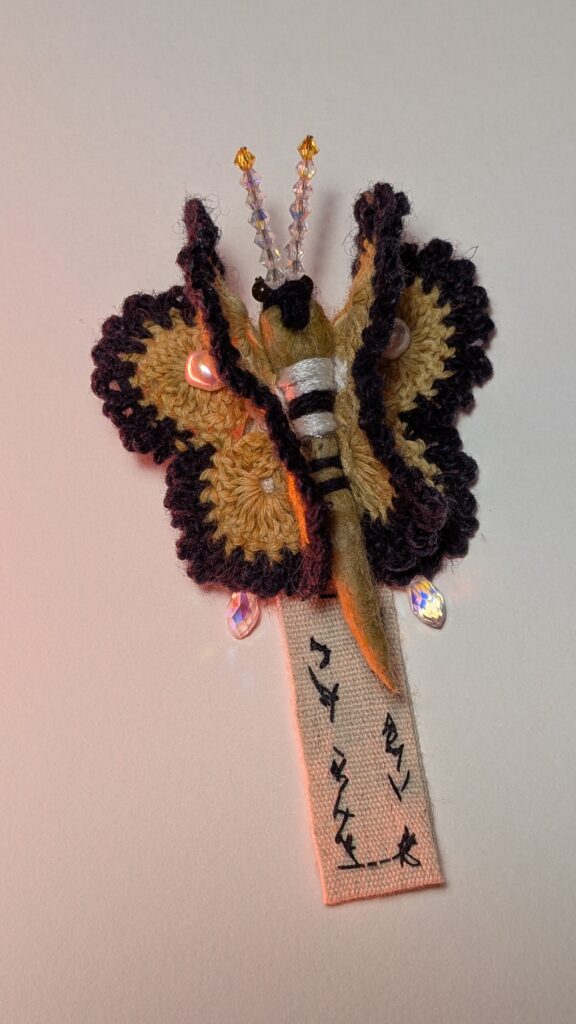
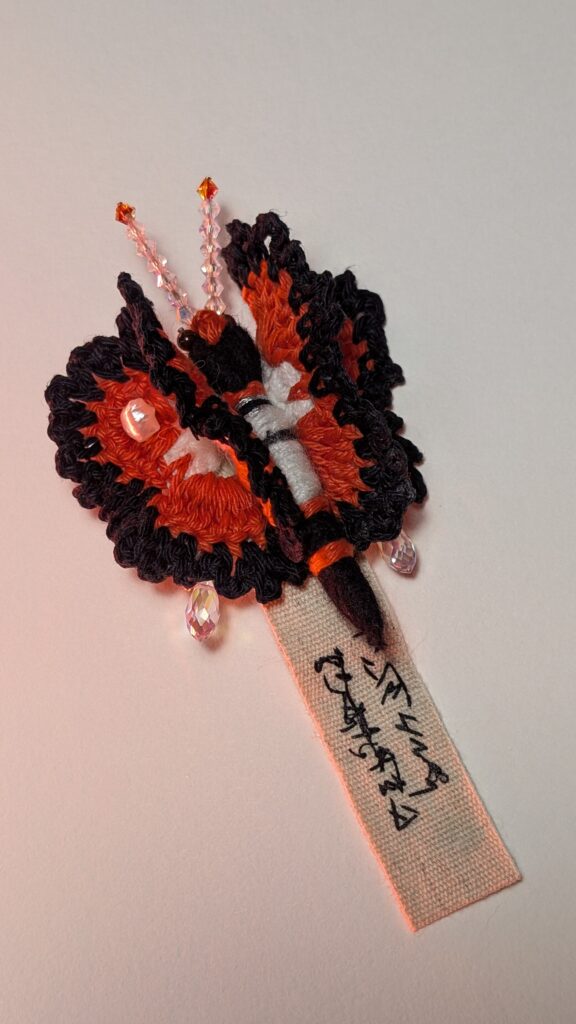
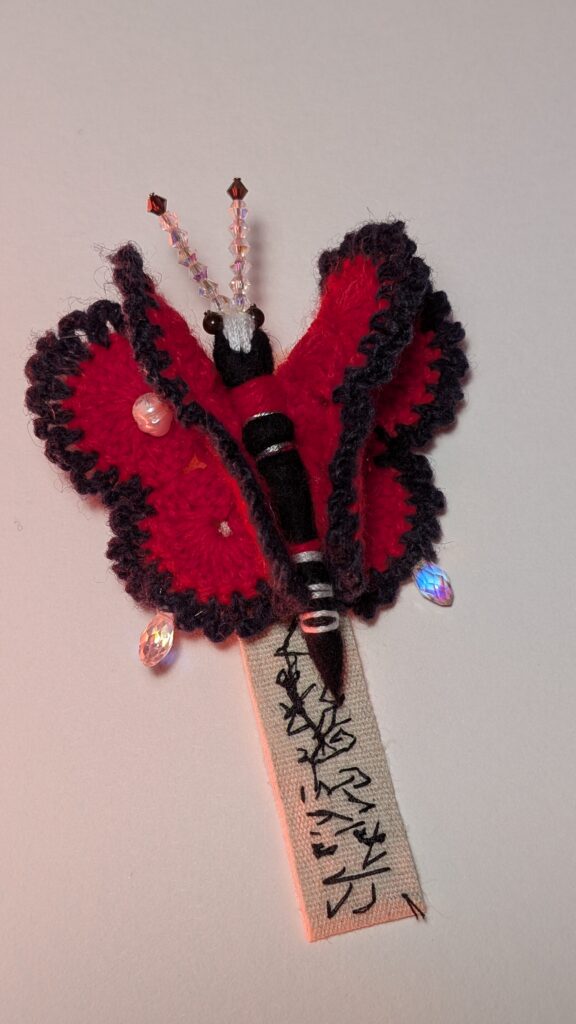
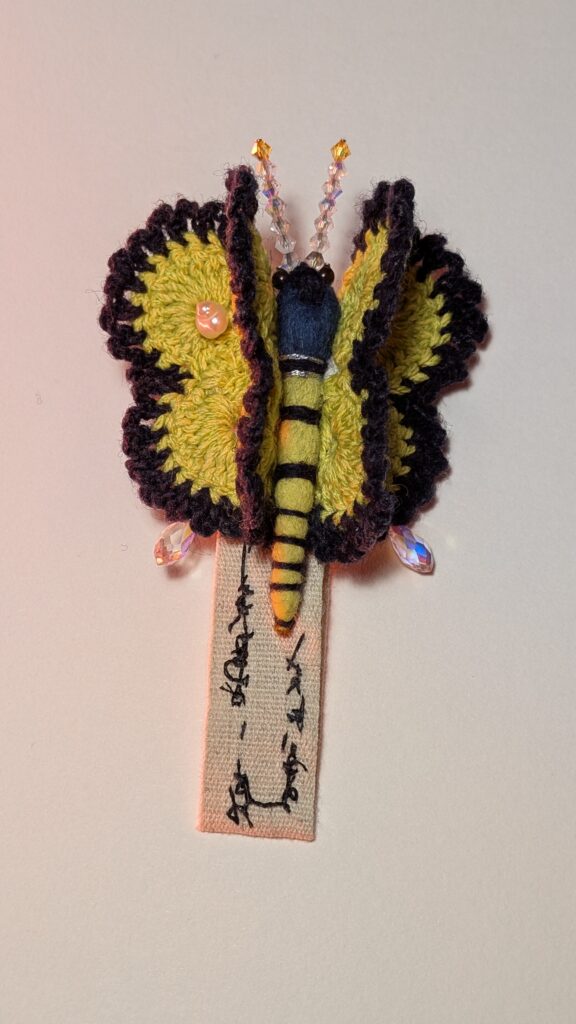
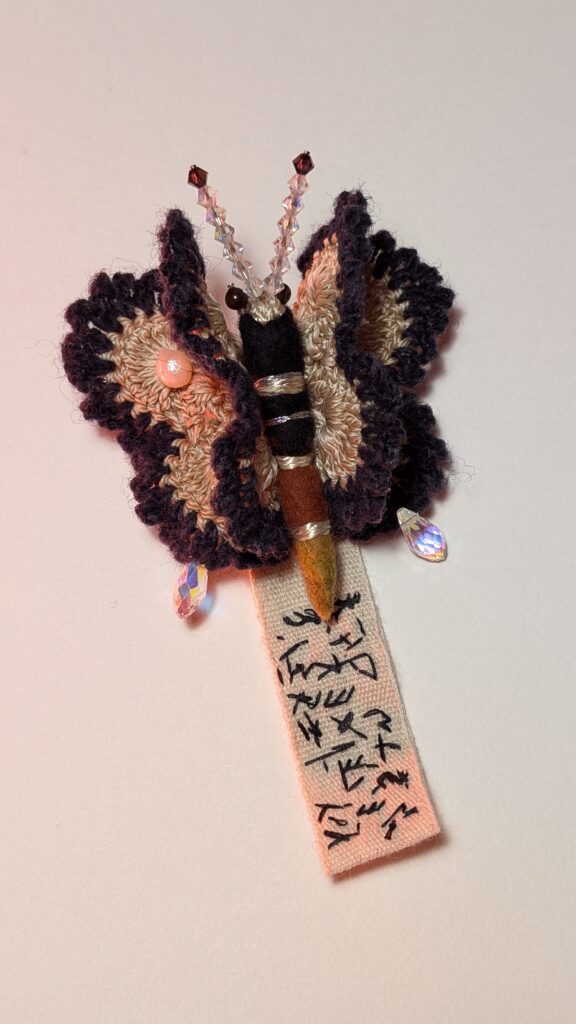
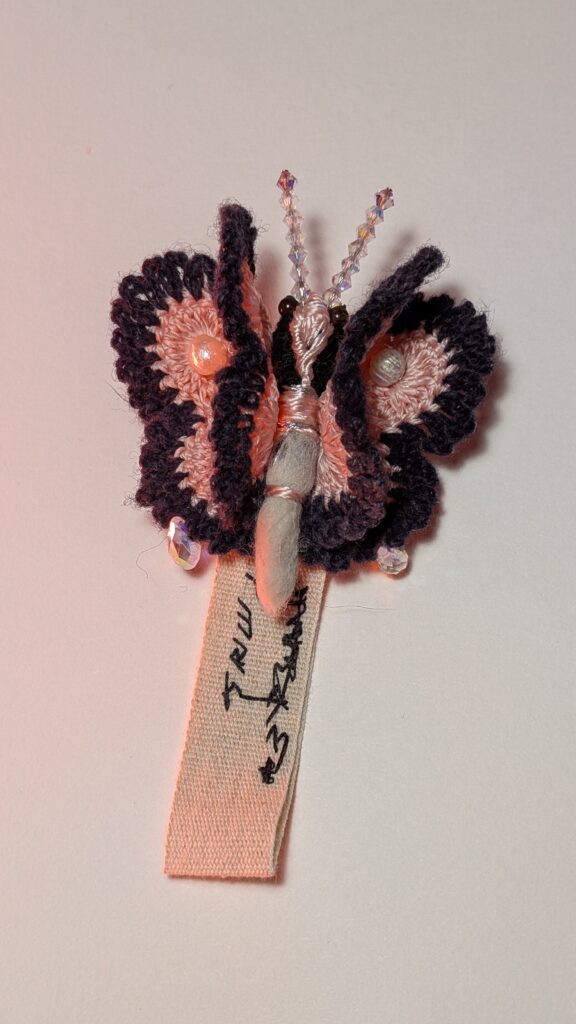
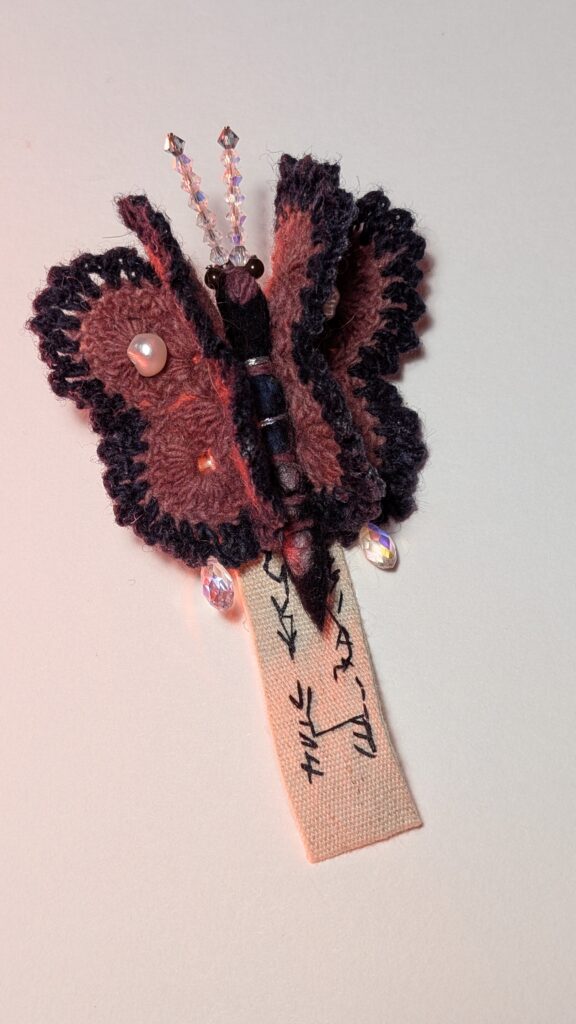
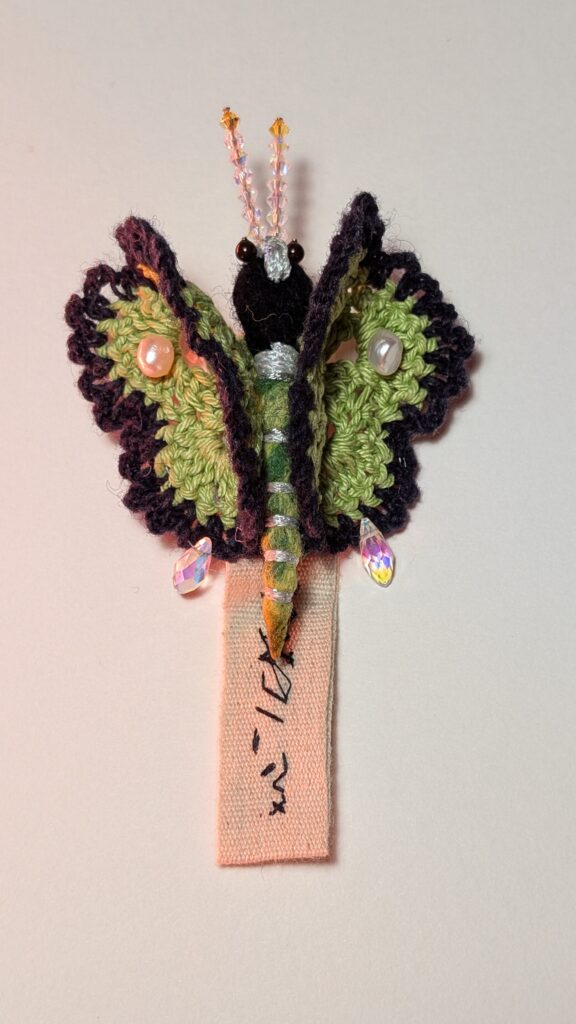
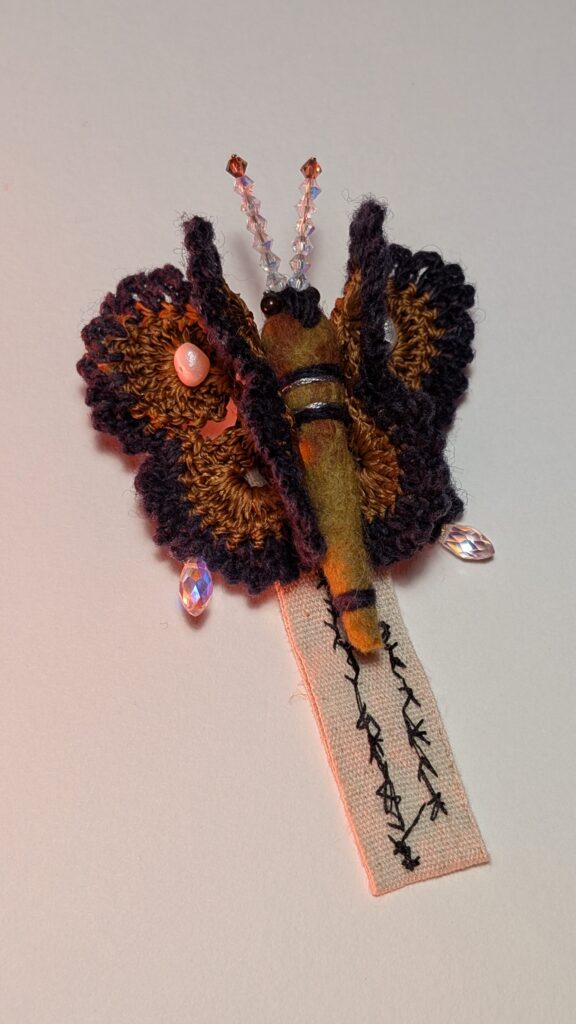
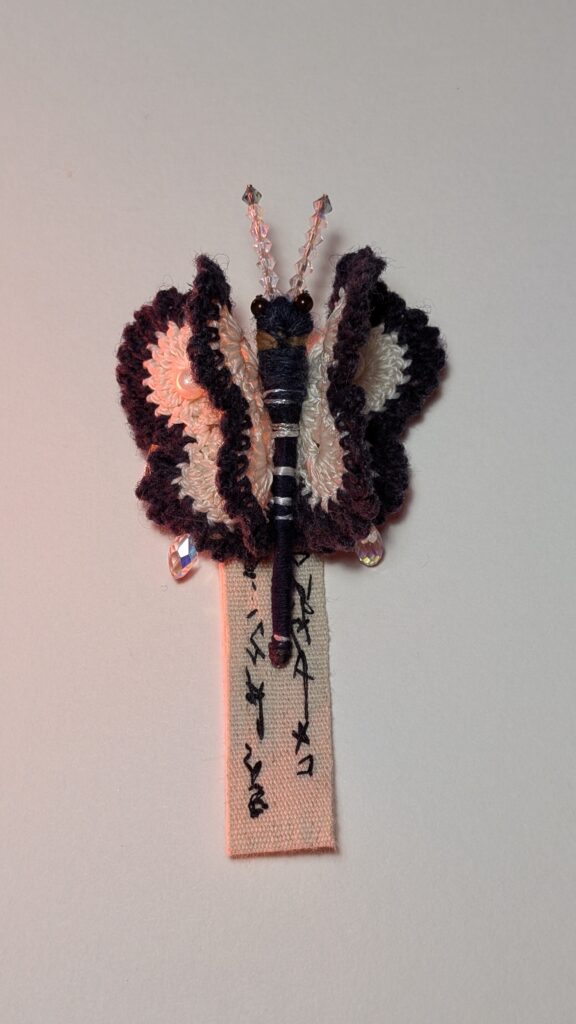
I clung to this image as if holding on to a thread. And I began a systematic, almost ritualistic gesture: I crocheted butterfly pins in cotton, wool and silk. Why twenty-one butterflies? Because my body asked for it, in a moment of synchronicity. Each one was born as a capsule of information that narrates relationships. They carry the colours of what I saw, often without eyes; the textures of what I touched, the flavours of what I ate, the thoughts that crossed my mind in tiredness and wakefulness.
They are small winged memories.
They are fragments of me in flight.
The Plot of the Shows: Lines of Resistance and Vanishing Points
When the Festival’s programme presented itself through me, I understood that the repetitive gesture of crocheting was neither a deviation nor a refuge, but a direct response to the urgency of doing that permeated the performances. What does the body do when it is moved by so many gestures at the same time?
Catarina Saraiva’s curatorship, proposing friendship as one of the possible antidotes to the abuse of language, that same language that sustains wars, genocides and erasures, quietly infiltrated my fibres. Something began to warm inside me.
Under the eyeless mask, I felt the surveillance proposed in Omegaville, by Los 3 Cerditos, like a change in air pressure. I didn’t see cameras, I didn’t read codes, but my body recognised the control as a continuous weight. While the play hinted at friendship as a crack in a closed system, I asked myself: what can I do with my hands? I pressed the point. I adjusted the tension on the thread.
If the world insists on wanting us to be legible, traceable, productive… my manual gesture:
done backwards,
slow,
failing
has become an area of technical and poetic autonomy. A place that escapes institutional radar. Knowledge that does not accelerate.
Selváticas, by Adriana Reyes, and Rasante, by Joana Levi, struck me like internal displacements. Reyes opened up the possibility of a non-hierarchical relationship between human bodies and plant bodies, between artistic practice and alchemy, between care and experimentation. How could I not hear in this a validation of my own work? Sheep’s wool, which carries within it animal life and the pastures that sustain it, reaffirmed itself as an ethical and sensitive choice. Working with it is an interspecific gesture; it is touching a living chain.
Levi, on the other hand, in dealing with migrations and extinctions, gave ground to my butterflies. I began to perceive them as migratory beings, fragile, crossing invisible borders. If the colonial machine insists on grounding the present of the future, my butterfly garden began to operate as meditative storytelling:
an exercise in keeping the unheard-of breathing.
In La Foresta Trabocca, Antonio Tagliarini speaks of the artist as one who sustains failure. What if failure were not a mistake, but a method?
What if my body couldn’t handle so much smoke?
What if blue didn’t present me with a sky?
What if I couldn’t breathe the technique that illustrates a poem in tatters?
The textual response I am constructing, in collaboration with performingborders, is a continuation of this expanded plan of encounters.
Se o Festival é um campo fértil, as minhas 21 borboletas operam como agentes polinizadores de corpo em corpo, de conversa em conversa. Quantos temas cabem num gesto pequeno?
The Oracle of Catchphrases
These Butterflies do not fly with empty wings. I transformed them into memory holders, embroidering on each one small, emblematic phrases gathered from shows and hallway conversations. Fragments of speech. The remnants of listening.
They function as poetic hyperlinks, these keys that allow the programme to be reopened in another temporality, one that does not end.
After the Festival, I felt the urgency to break the distance. The butterflies became oracles.
I wrote to distant friends. I asked for conversations. I asked for time. How can I reduce the kilometres between us without moving my body?
In these exchanges, the safe and nameable answer I was looking for dissolved. What emerged was something else: unperformed friendship.
Vulnerable.
Emotional.
A place of refuge.
The Butterfly House of Perspectives: Life-Saving Conversations
That is why my time at Linha de Fuga did not end on 30 November. The Festival continued to affect me as something that needed time to be digested.
The impact on my body created an excess,
crossed,
led me to seek out other people to organise what I had experienced.
This gave rise to conversations that I came to call oracular acts of proximity, far from any mystical meaning, but rather as a practical attempt to hear what the festival still had to say through others.
Creating the butterfly garden was not just an aesthetic or conceptual choice.
A butterfly garden to inhabit, was the direct response to my need for support. Calling on my network of loved ones was a way to continue the work and, at the same time, protect myself.
The festival demanded attention, presence and availability; the response was to create spaces where this could be done calmly.
Of flights between friends
With Borboleta B, the conversation started with the phrase “network of action”, taken from Rasante, by Joana Levi. We talked about the show and how it addresses the relationships between humans, animals and power systems linked to exploitation and colonialism. B brought up the idea that friendship is a form of faith, not religious, but everyday, an active trust placed in the other. This helped me realise that many of the relationships activated during the Festival are not based on formal agreements, but on a continuous presence, sustained over time.
We also question the word ‘encounter,’ which often fails to convey the intensity and complexity of what happens between people. The butterfly, as an image, appeared here less as a symbol and more as a way of existing: without guarantees, in direct relation to the environment. Talking about happiness, about the desire to live, became, in this conversation, a concrete form of resistance.
With Borboleta E, the conversation revolved around the idea of “being and dying”, something that already appeared in my notes from vulnerable conversations*. We talked about friendship as a space where there is no constant demand for performance, perhaps a place where it is possible to make mistakes, repeat, learn. And I brought up the image of sculpture as a slow process: we are shaped by the relationships we maintain. This conversation was directly linked to Adriana Reyes’ Coreografias Selváticas.
The notion of care emerged powerfully. Just like a plant, friendship needs attention; if it is not cared for, it ends. Death entered here as a measure of the real time of relationships. The butterflies I made serve as attempts to preserve these short moments, these experiences that are normally lost.
With Borboleta L, we talked about precarious work, fatigue, and the difficulty of sustaining artistic practices in unfair contexts. The phrase that stuck was “spaces of proximity.” We talked about the right to opacity, about not always having to be available or explainable. For her, friendship is a flexible structure that adjusts to the needs of each moment.
This conversation helped me realise that my role in the Festival, besides responding artistically, was also to create small spaces of intimacy, where it was possible to take a break from the intense pace of the programme. When she told me that I was part of several stories without knowing it, I understood once again the butterfly garden as an archive of these relationships, a place where these exchanges are stored.
With Borboleta R, the conversation took on a more critical perspective. We spoke directly about the idea of the “performativity of friendship” and the contradiction that this can represent. For R, friendship is not a strategy; it is a horizontal relationship. This view helped me to reposition my work: to see the mask and the 21 butterflies as devices for reading, multiple listening and oracular practice.
With Butterfly N, the conversation focused on resilience and care. We talked about the responsibility of being positively present in the lives of others. For N, resilience does not mean fighting all the time, but finding ways to keep going, to reframe difficulties. We went through the different stages of friendship and it became clear that there is no deep emotional relationship without vulnerability. The butterfly garden thus became a record of this conscious exposure: being open, but with support.
With Butterfly C, the conversation opened up a field that we called the Laboratory of Affections, and it was a particularly enlightening exchange because it helped me to gently and precisely broaden my understanding of what I had already been doing intuitively with the butterfly garden. We talked about the origin of this term based on the processes shared in Linha de Fuga and the meetings in another laboratory where we met, in which we understood performance as a common territory of experimentation and listening.
The memory of the 2020 pandemic permeated the conversation as a turning point: making art at that moment was a gesture of survival, a pact of mutual protection, and this also repositioned “the encounter” as a place of refuge. From there, a distinction emerged between performativity and friendship, performance as a possible mask, a mode of relationship that does not require total transparency, and friendship as that rare space of non-performance, where there is no need to sustain characters.
This had a direct echo in my work. I realised how, often, artistic vulnerability is confused with intimacy, when, in fact, it still operates within a performative framework. The laboratory, as we said, is the place where this confusion can be tested, proven wrong, reviewed.
C also brought up the complexity of friendships in adult life: this process of filtering, of silently negotiating expectations, based less on constant proximity and more on shared vibrations. This made me see the butterfly garden even more as an archive of encounters and as a poetic proposal that arises from the body in relation to the world, a butterfly garden of relationships, where image and word attempt to give shape to unstable connections, to the boundaries between performance and affection, and to the multiple sensitive transformations that guide, expand, and multiply the paths of my creation.
With Borboleta V, the conversation brought another kind of time, longer, deeper, traversed by memory and permanence. We talked about dreaming realities, with insistence. She said she knew me as a boy, passing through the streets around the church in the rural community of our origin, and that image opened up a whole layer of reflection on how relationships are built throughout life, even at different ages, even without immediate awareness of what that would become. In a way, falling into V’s life was a big event: something unplanned, but deeply remarkable.
We talked about friendship as a feeling, as a substance. If we think of friendship as an art, then we are made of the same substance as it, a felt truth, impossible to put into words.
Art, said V, always awaits our dreams. We recognised that we came from a very poor area of Brazil, a place where dreaming was a risky gesture, and where only conversations, care and emotional bonds managed to save lives and preserve desires. This made me understand the butterfly garden as a gesture deeply connected to this history: an attempt to preserve not only encounters, but dreams that persist, realities that could have been interrupted.
Artists, as V and I discussed, create things, words, and even meanings.
And perhaps that is what the butterfly garden is: a space where these invisible substances of friendship, memory, and art continue to breathe, transform, and sustain the many paths of creation and of response.
Collectively, these conversations served as a practical continuation of the festival. The butterfly garden maintained active relationships.
The safe place of dissidence and the impact of the body: an open conclusion
The collaboration with performingborders is what allows this text to exist outside the demands of academic writing. Working with Xavier again opened up a space where thought does not need to be simplified to fit a format.
Here, my writing does not need to comply with protocol. I can invent words, lengthen sentences, test forms that are still unnamed.
Wearing the mask and crocheting was a way of refusing the rapid consumption of performance and remaining present without exhausting myself. The body functioned as a filter: instead of accumulating exhaustion, it transformed political charge into a continuous, manual, repeated gesture.
Activating the butterfly garden to the network of affections was the last point of this reticence
Organise the experience.
Record it with my body.
Traversed, developing affection to continue differently, __________transformed.
In the end, friendship defies definition and is structured around practices: a network where one can fall
stop,
start again, without breaking.
This is the textile text that runs parallel to my experience at Citemor, permeated by the uniqueness of Coimbra and Linha de Fuga.
Once again, the seam that is not on stage.
What I am presenting now is the union of words and visuals, of writing and thread.
A logbook where writing is performative and crochet thinks.
Where the body responds because it has been touched,
and continues.
After all, crochet thinks…
Ed.








—
Commissioned by performingborders and Linha de Fuga 2025, with curation and accompaniment by Xavier de Sousa
Ed Freitas is a visual and transdisciplinary artist born in Northeast Brazil and based in Coimbra, Portugal. His work interweaves performance, installation, sculpture, and textile art, investigating the Installative Presence — a concept he explores through his PhD in Contemporary Art at the University of Coimbra. Through fabrics, mantles, and sensory objects, he builds poetic devices where the body becomes a living archive of ancestry. Recipient of the World Cultural Council Award (2022), Freitas’ work operates between political tension and embodied sensitivity. His international presence spans festivals, exhibitions, and residencies across Brazil, Portugal, France, Romania, Germany, and the US. He also works as a curator, educator, and critical thinker at Ateliar Nuno Fonseca in Coimbra.
@ed._freitas