Poetry, Protest, and Political possibility | Leena Habiballa
08th June 2026Leena Habiballa critically reflects on Amel Moyersoen’s moving image work afraid of losing the echoes, it’s socio-political context and potential.
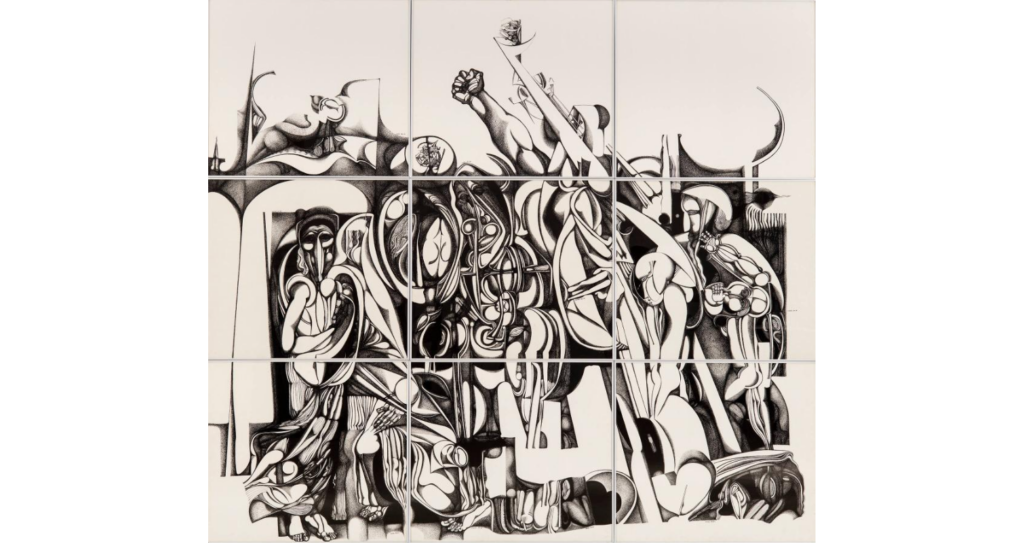
Often considered Ibrahim El-Salahi’s masterpiece, the painting The Inevitable (1985), was recreated from disparate sketches on cement casings made during the Sudanese artist’s unlawful imprisonment in Kobar in 1975. Conceived over a period of 10 years, the 9 panel work is a fractal where each singular part simultaneously contains and configures the whole. El-Salahi explains how the work grew like a seed, spreading out from a ‘nucleus’ to reveal its own meaning to him in the act of creation: that “the people must rise up and fight tyranny and those who suppress them.”
Amel Moyersoen’s moving image work, afraid of losing the echoes (AOLTE, 2023), brings to life this fractility of the protest, where love and loss become co-constitutive and where a movement discovers itself in its making. Taking protests against police brutality in racialised communities of Brussels (1991-2023) as its points of departure, the film calls for a remembrance of precious lives taken at the hands of the police and is a testament to the strength and endurance of community resistance. Drawing on archived interviews with community members affected by police harassment and brutality, the film slowly swells and surges with rage until it bursts into movement.
AOLTE depicts the space of the riot as one of renewal, where the dead spaces of the city are resurrected and reconfigured into spaces of political possibility. Using a collage of precise yet evocative cuts, Moyersoen beautifully captures the feverish energy of the protest, this event with no name, in which our fates become one and the future collapses into the present. Leaning into this alternative temporality, Moyersoen visualises the ways the kinetics of the protest transform the streets into a stage, revealing the performative choreography of racialised systemic violence and its fragile regimes of entrapment and containment.
In turn, the riot becomes a rehearsal of a political otherwise, a poetic insistence on maintaining a space of radical imagination as an open field that equally embraces its agitational potentials and contradictions. There is a meditative nature to the gestural repetitions on screen – the throwing of a molotov cocktail, crowds dispersing and converging, signs, chants, and marches – the choreography of a breaking and remaking of social life and relation. This repetition, alongside the temporal jumps between eras and frantic camera movements, creates a sense of urgency while mirroring the cyclical nature of police violence.
In Go Outside, Hannah Black notes that “The police exist in passionate opposition to crowds. […] They are against escape and against gathering. The streets are the frame and context for working-class social life, so the police limit the pleasures that can be experienced there.”
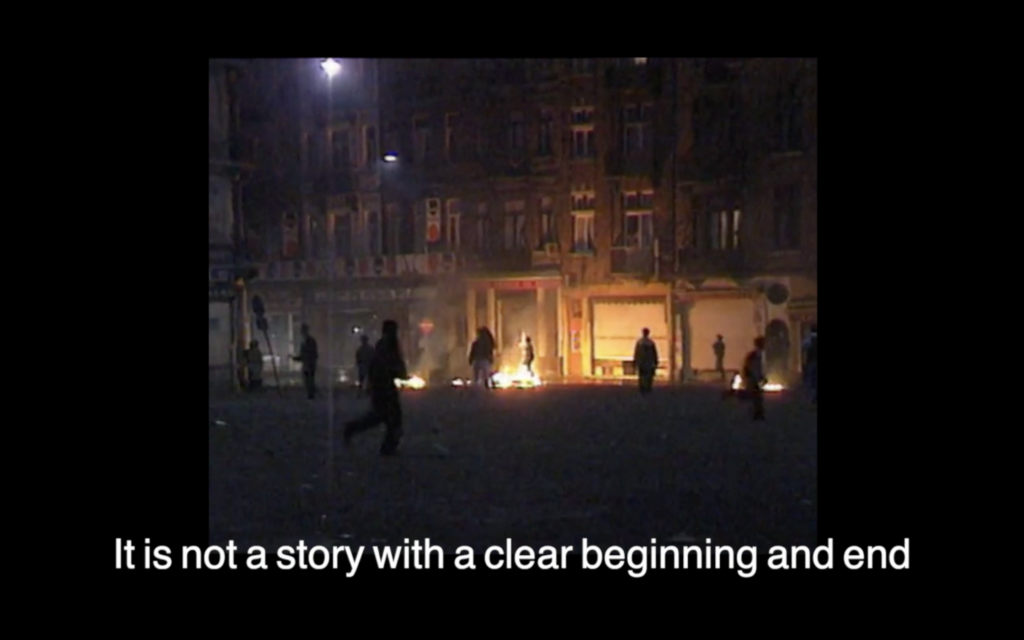

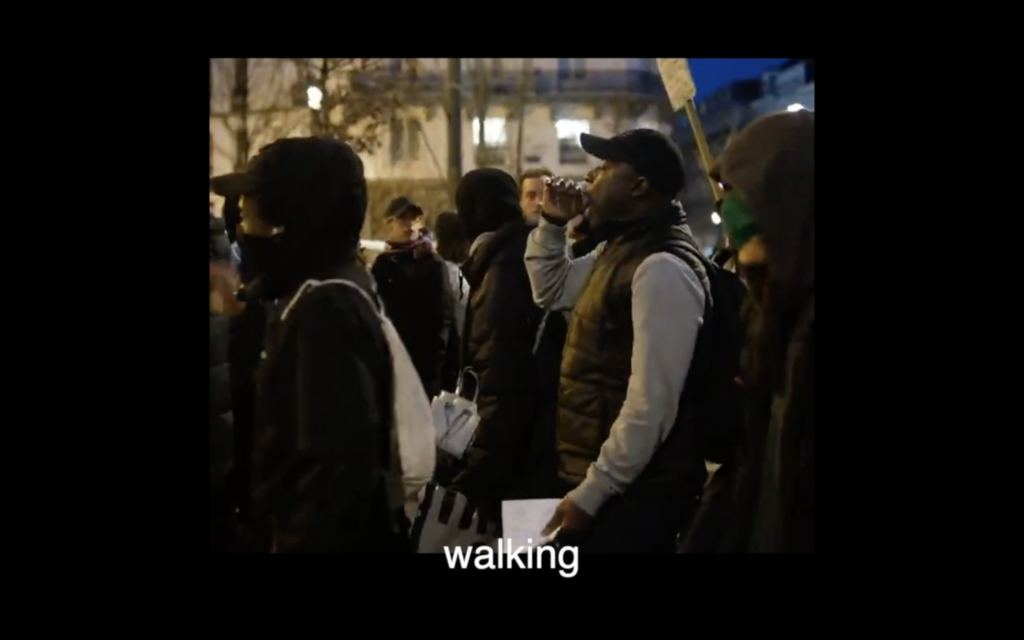

Conversely, AOLTE limits the anticipation of a collision with forces of law and order through premature cuts and never affords us the assumption of the inevitable clash. This deliberate omission presents the police as marginal, grounding us instead in the aesthetics of community resistance; emphasising collective strength rather than individual suffering and highlighting the ingenuity of resilience over the battering of bodies on the street. In this way, Moyersoen works to reconsider representations of police violence, finding alternative aesthetic strategies to depict violent histories without reproducing oppressive visual languages.
The overlaying of text, voiceover and subtitles work together to create a new orality of protest that transcends the singular narratives of the state. This polyvocal, textured, fragmented and insistent patchwork of grammars makes of witnessing and documenting a participatory, imperfect, and alive thing. A vibrant counter-archive waiting to be transmitted in the afterlife of the protest. “Who will forget?” asks the voiceover in the final scene, lamenting the present’s mirroring of the past, how each era gets separated from the last. Here, memory is not neutral, it is a political terrain subject to equal repression by the state. Moyersoen’s careful stitching back of these moments together through rhythmic montage, creates a continuity and genealogy to this resistance, guarding against the amnesia that isolates each protest/violence from the other.
Moyersoen continues her investigation into resistance as a practice in Beginnings (co-directed with Niki Kohandel, 2024), her most recent moving image work. Using stop-motion and the voice/writings of Nia Fekri, she weaves a visual poem about the endless pendulum swing between defeat and resistance against the tide of imperialist violence. We float along a river carrying various messages on boats – breath, prayer, love, resistance, burn, riot – streaming to meet the sea of “anything anything anything other than this.” Beginnings holds both the grief and potential of revolt; the insurgency’s rhythm of rupture, rapture, finding each other, destruction, rest and starting anew. Time is warped into a circle, with no end and beginning and with no certainty but for the endurance of resistance and a love that “uproots everything.”
Moyersoen’s unique moving image work brings to life forgotten and misremembered migrant histories enriching our collective memory of resistance against state violence. Resurrecting and narrativising these diasporic archives through a highly accessible visual form offers the opportunity to restage these genealogies in the present and connect dispersed political imaginations and communities. AOLTE and Beginnings craft a poetic challenge to traditional historiographical methods that use archival evidence to secure stable narratives and analyses of the past. They suspend the subjective difference between the moment of viewing the work and the indexed archival histories underlying it, replacing resolution with the delivery of open-ended political possibilities. An extended search rooted in a shared imagination and orchestrated by the meeting of strange and familiar bodies on the street. In this encounter, and for a few moments, the romance of the streets reveals to us that there is more dignity and humanity in being together, that there is more ecstasy in the world we are seizing together than in the one left behind.
Watch afraid of losing the echoes:
***
Leena Habiballa is a Sudanese writer and artist based in London. She investigates legacies of colonialism, the politics of visual and material cultures, and archival film practices that subvert state and colonial ideologies. Her writing has been published by Art Monthly, Nka: Journal of Contemporary African Art, Danish Film Institute, LUX, and Ultra Dogme. She is Co-Director of the artist workers’ cooperative not/nowhere specialising in analogue practices. @carbonbasedfunk
Amel Moyersoen is a visual artist, programmer, and researcher interested in histories of militancy, memory-making and transmission in the diaspora. She is currently developing a research initiative exploring migrant film making and networks of film distribution in 1970sand 1980s Belgium as part of the NAAS Fellowship. Her recent curatorial work includes contributions to; Safar Film Festival, Otherfield Festival, atlas cinema and the ongoing monthly Majlis Filmclub at Other Cinemas. Her film ‘afraid of losing the echoes’ and collaborative film ‘Beginnings’, with Niki Kohandel, have been shown in a variety of spaces including under bridges, in cafés and community centres, as well as at cinemas and festivals in London, Brussels, and beyond. Screenings include; Images Festival, The Post Bar, Showroom Gallery, System_D Festival, Metroland Studios, and LUX. @amelk_