From the Lips to the Moon: A stubborn hope against hope | Anahí Saravia Herrera
16th September 2026Anahi Saravia Herrera listens for what the present sounds like amid war, collapse and the exhaustion of hope in Tara Fatehi and Pouya Ehsaei’s new album From the Lips to the Moon. Listen via Bandcamp here.
It’s rare to find a piece of work that can function as a stenograph.
So delicately mapping what the present sounds like, tastes like, feels like.
A stenograph that traces how the now sticks to our skin, how it rolls like lava down a hill, how it tastes in our mouths, how it burns to swallow, tracing how it might be digested into hot coals. As I listen to the album From the Lips to the Moon, brought together by London based, Iranian-born duo Tara Fatehi and Pouya Ehsaei, I hear my comrade ask:
If the moment could speak now, what would it say?
There is a hopeful answer to this question, but living through an apocalyptic landscape that unfolds in all directions, in slow motion and as a jump cut, a world in which everyday brings a new kind of death, the proposal of a forced hopefulness feels demobilising, like another link in a long string of delusions that we tell ourselves to keep justifying what no longer makes sense.
In a conversation about the work in the WORMS magazine blog, Pouya asks:
What does it mean to have an angle when everything is flattened out and we’re all spread out on a paper thin plane of nothingness?
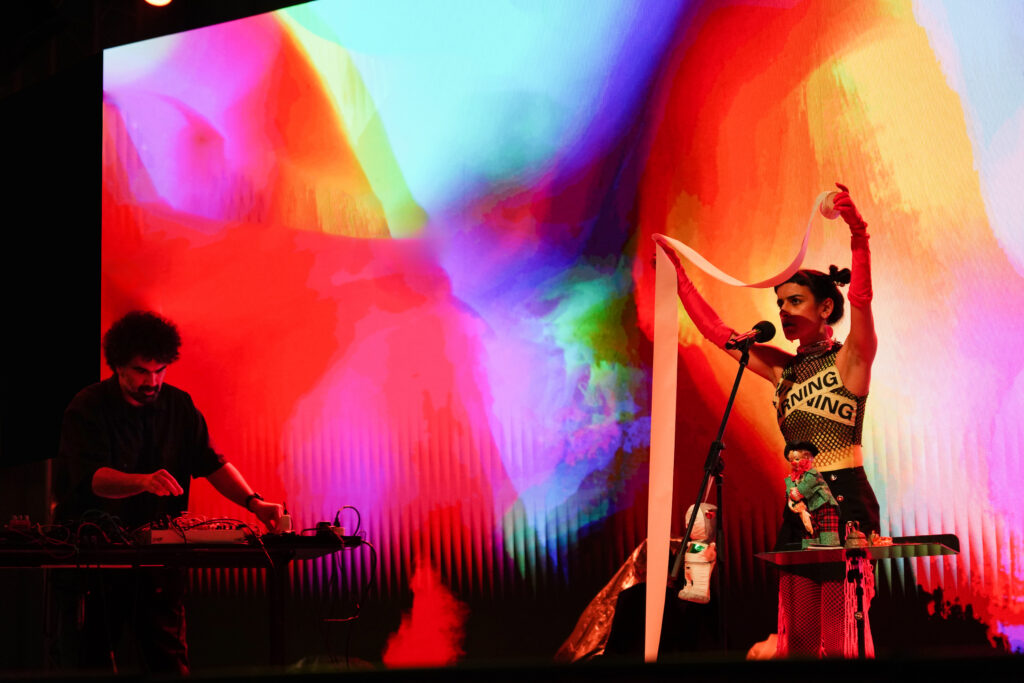
From the Lips to the Moon | Photo by Raymon Lee
From the Lips to the Moon does the hard labour of sitting in this moment of hopeless, senseless hope, without providing an easy out. Instead, Tara, Pouya and all featured performers and poets unfold a landscape of open-ended sonic conversations, rubbing words, sound and music across supermarket lines, in the belly of the empire, at home, wherever that may be. It is an album that came out as the war in Iran, Lebanon and Palestine happened in real time. An album that tries to articulate a politics of hope, asking:
How do we live in the destruction of all that we know?
This album grows from the experimental performance, poetry and music nights by the same name that have happened in London, Mexico, Berlin and beyond over the past few years, inhabiting the many borders of disciplines, politics, language and poetics. In this sink space, Tara acts as a performative host alongside Pouya, whose eclectic mix of electronic music carries the night, weaving through jazz, industrial sound, techno, and Iranian folk. All of the collaborating poets and musicians (including Tamar Osborn, Tim Etchells, Kareem Dayes, MA.MOYO, Nomakhwezi Becker, Oluwaseun Olayiwola and Nisha Ramayya) have performed live as well as being featured in the album, enveloping the audience in an improvised space, turned listening session, turned collective dream. These nights open momentary portals, like falling into a sinkhole that lets things pass through us for a moment—a simultaneous softening and rupture in the thin borderland of hope and despair.
This space doesn’t run away from the sharp edges, it actively dances on them without trying to soften the blow, bringing a rare relief in the context of a permanent crisis. In Empire, a deep crackling rumble sounds like it’s coming from deep beneath the earth’s crust and Maureen Onwunali says:
Who feeds the beast they call empire?
I spit gasoline
Burn London bridges
The taste of now is burnt gasoline on our tongues, an endless toxic that consumes us. Ultimately, the more we think about what the function of art is, the more artists try to engage with the inescapable brutality of the moment we’re living through, the more it feels like art is unable to hold the full weight of this moment’s urgency. The contradictory nature of how we make and consume art falls heavy, our deep entanglement with the very systems that create the crises become unavoidable. We begin to sense that even within cultural sites, we’re only re-performing the very thing we’re trying to escape. This makes certain art work feel empty, political articulations of liberation become de-fanged, it is not rare for me to read a curatorial text that broaches feminism, de-colonial politics and anti-imperialism with more cynicism than hope.
In the face of this, From the Lips to the Moon feels honest about the loss of any naïve sincerity. Rather than reaching for reassurance, it turns toward what might emerge from naming everything we have lost, without gaslighting ourselves into believing that everything will be okay. It offers no promises, only the space to speak.
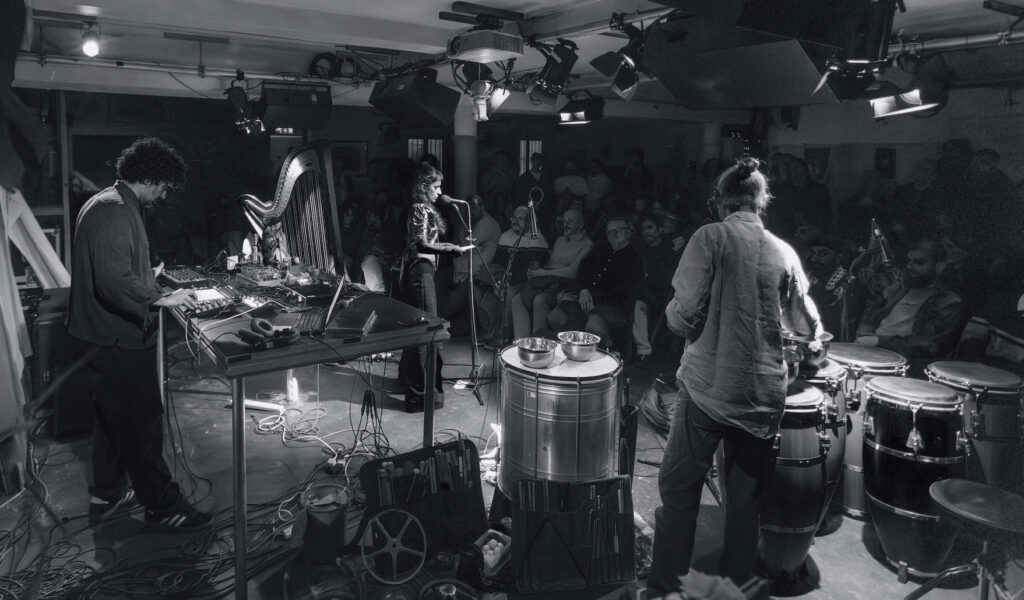
From the Lips to the Moon | Photo by: Jemima Yong
In Bulldozer, to an eerie upbeat melody that collapses into a deep resonant bass, Tara says:
In a time where elephants roam on stilts, and monkeys sprout wings to soar through the skies, shadows morph into gargoyles whispering secrets and conspiracy theories that defy reason, I see a bulldozer.
In this shadow realm, where our words are twisted by gargoyles, we are learning to wrap our heads around the absurdity of the now. We are seeing how perhaps the only way to speak to it is through poetry that meets the surreality of a late stage capitalism that defies all moral logic. Within this space, an inexplicable desire persists: to gather, to attempt another way of performing life together, even knowing we may fail. This alone feels like an honest gesture, one that motivates us to keep trying to find the words to make new worlds through our grief, and not despite it.
The performance universe of From the Lips to the Moon feels alive. The sound opens depth into closed dimensions, ones which are yet to be spoken into existence, but which must exist somewhere in the rubble of everything that has been destroyed. This quality of liveness, literal and speculative, is mirrored in the album, a twelve track work that moves through grief, anger and absurdity, ending on How We Love, featuring Tasneim Zyada and Yelfris Valdes, whispering:
How we love
is how the heart squeezes
to pump reasons for you to live,
like holding hands when crossing borders
carrying home in your womb
and shoulders.
From the Lips to the Moon does not look to announce a radical politics through declaration, nor does it look for a definitive articulation that might finally reason our way into a solution (because really, there is no going back). Its politics lies elsewhere in a lineage of sonic anti-fascism, as proposed by Ukrainian experimental musician and academic Anton Katz: a collective exercise in transmission and reception across disciplines, an intention to cultivate listening individually and collectively against the world-ending forces of fascism that foreclose our capacity to think beyond a future of destruction. From the Lips to the Moon invests into a process of re-sensitisation, an exercise in feeling into the present, through a pain that feels wordless. In the album there is an opportunity for deep feeling even through hopelessness, beyond it lies a desire to continue to find reasons to live together. It is a sonic manifestation of a stubborn hope against hope.
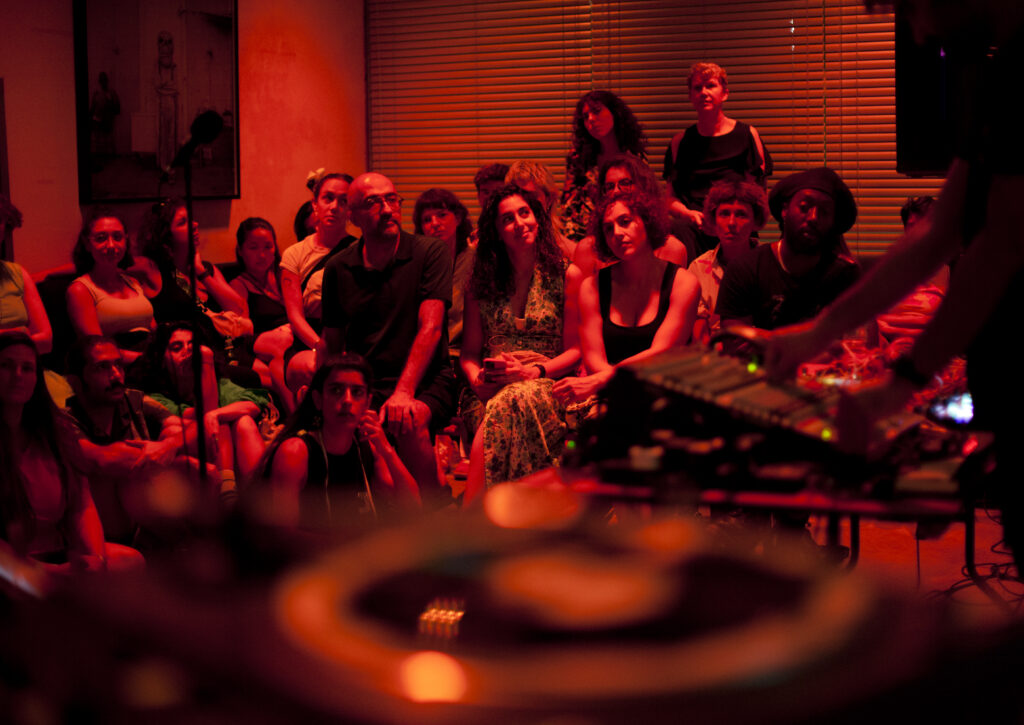
From the Lips to the Moon | Photo by: Holly Revell
From the Lips to the Moon was released on 8 May on Akazib Records. Created by London-based duo Pouya Ehsaei and Tara Fatehi, From the Lips to the Moon brings together a cast of London’s fierce, current, and transcultural voices, fusing live electronics, performative poetry, unearthly melodies, noise, and twisted beats. Their debut album delves into four years of live encounters, remembered as much for their spontaneity as for their unity. This is a record defined by its contrasts: gritty, sharp-edged electronics, raw vocalizations, and organic instrumental textures give way seamlessly to moments of soft, profound tenderness.
Anahí Saravia Herrera works at the intersection of community organising, writing and publishing. Her work explores how cultural spaces can hold political questions and build collective infrastructures. She is currently a Civic Fellow at Cubitt Gallery, cares for performingborders, and is incubating slow+dirty press, a community-led feminist press based at House of Annetta. Lives + works in London, UK.