Between October 2025 – March 2026, performingborders collaborated with writer and researcher Diana Damian Martin on methods of critical thinking around performance, through writing that responds to political crises, open up speculative and abolitionist approaches to criticism and shapes nonconforming editorial practices.
Set as a series of responses that stem from Diana’s book Nonconforming Criticisms: Political Practices and Poetics at the Borderlands of Performance (September 2026), we developed a series of study groups, events and commissions working (digitally and in person) with writers, critics, performers and artists. This included a series of digital labs with participation from writers from around the world, who gathered over 4 months to think together about critical practice (see more information here).
Through this process, and with contributors to the project, we assembled our latest publication Nonconforming Criticisms, a toolkit that gathers thinking developed throughout the project featuring writing from Diana Damian Martin, Fargo Nissim Tbakhi, Odete, Season Butler, Pedro Vilela, Ed Freitas, Claudia Galhos, HUSS and Leticia Maia.
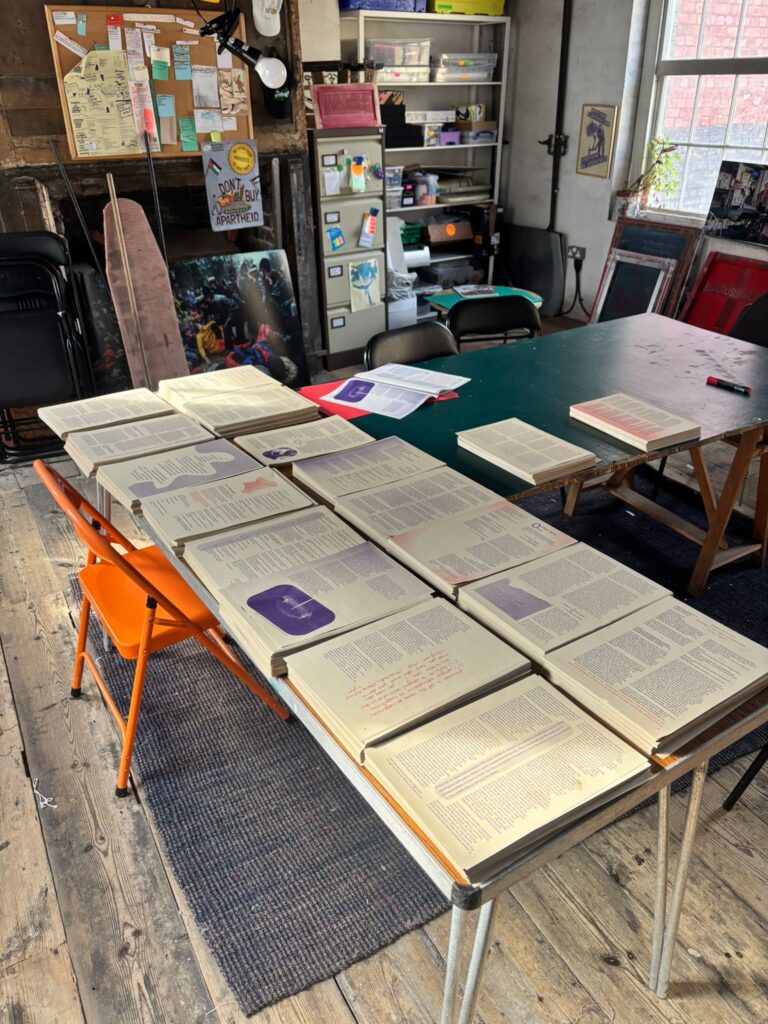
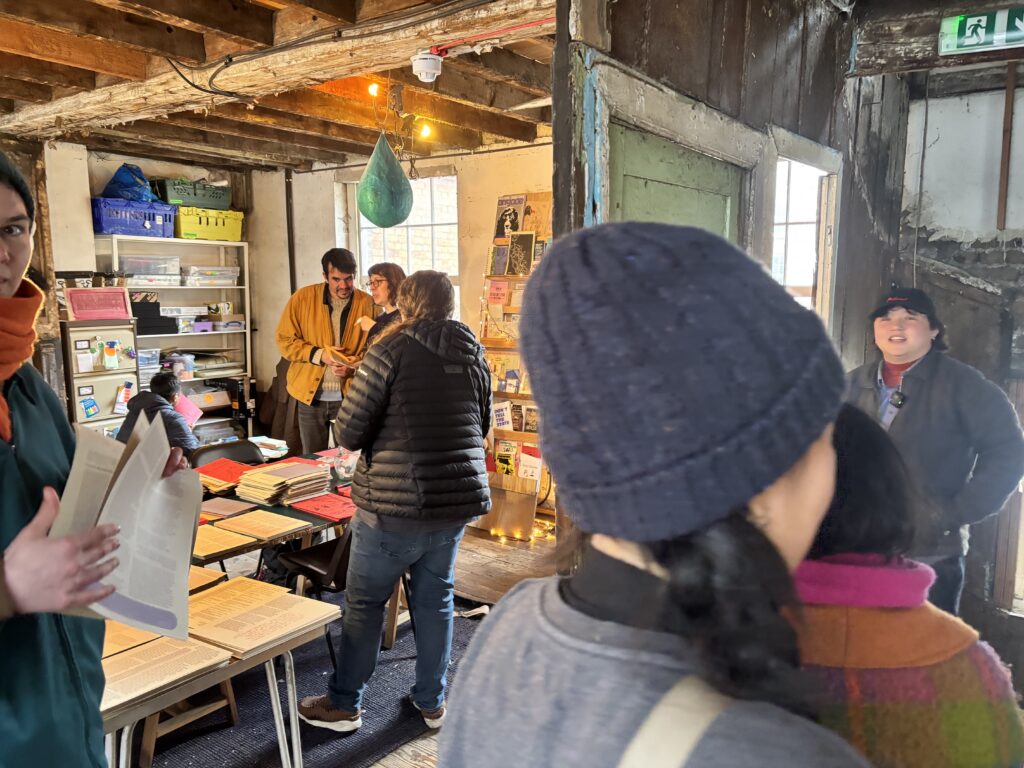
The toolkit was collaboratively made and printed at House of Annetta in London with slow + dirty press in March 2026. It was bound through a printing workshop turned performance exploring the risograph and the performativity of publishing. The toolkit was launched at MayDay Rooms on 23 March 2026, alongside a panel discussion with critics Juliet Jacques, Jemma Desai and Maddy Costa, which explored the intersections of writing, experimental practice and political work.
Below you will find the collection of texts featured in the toolkit, as well as a digitised version of the publication.
If you would like a physical copy: [email protected]
INTRODUCTION | Diana Damian Martin
Welcome to this Toolkit bringing together reflections, strategies and approaches to nonconforming criticisms.
We begin with three loves.
The first, from Caribbean poet Eduard Glissant in Poetics of Relation: “Thinking thought usually amounts to withdrawing into a dimensionless place in which the idea of thought alone persists. But thought in reality spaces itself out into the world. It informs the imaginary of peoples, their varied poetics, which it then transforms, meaning, in them its risk becomes realized.” (1990)
The first, then, is a love for thinking as something always in and of the world, and something not that withdraws, but that brings together.
The second is the minor gesture, a concept by theorist Erin Manning that breathes attention into the gestural force, the potential variation, a neurodivergent politics: “a thought less concerned with the certainty of what it knows is more open to the minor in thinking, more open to the force of the as- yet- unformed coursing through it. This minor tendency values the force of form, not just the form knowledge takes.” (2016)
The second, then, is a love for the force of small gestures, minor uncertainties, spaces for ambiguity, and allowing form to settle differently. bell hooks, leading Black thinker of love, who reminds us that ‘To know love we have to tell the truth to ourselves and to others […] If love is really the active practice […] it requires the notion of being a lover, of being in love with the universe.’ (2000)
The third, love itself – being in love. Love of performance, love in performance.
In this Toolkit, we gather research, methodology and forms that sit at the intersections between critical practice, performance, organising and abolition. Centering experimentation and an interest in how we do critical thinking now – be it through language, movement, materiality, traces, conversation – this Toolkit gathers the work of critics, artists, writers and thinkers making space for small gestures, for uncertainties, and for sitting with the difficulty of criticality, of love and grief in times of genocide, war and censorship. Here we bring together texts, reflections and provocations on experimental and politically engaged writing in response to performance and live art, and take up critical writing as a mode of engaging with anti-colonial and abolitionist practices. How can critical practice be a space for imagination and resistance? How can we resist functionalising critical writing? How can we weave together our work as artists, organisers and thinkers towards new forms and approaches?
These commitments accompany us on this Toolkit; they make critical thinking and practice material, embodied, palpable. They support it taking space across its contributions, and performing its many entanglements. They open up borderlands between the many collaborators, concepts, networks, participants, workshops, gatherings and reflections that make up the tapestry of this programme – a minor gesture, a framework.
Nonconforming criticism is a framework for encountering forms of thinking from and about and as performance that are not legible as criticism. Their refusals, experiments, encounters shape forms of criticality. This Toolkit emerges from a weaving together of research, reflections and practices from my decade-long research and collective practice presented in Nonconforming Criticism: Political Practices and Poetics at the Borderlands of Performance (Methuen Bloomsbury 2026), the Live Art Writers Network – an expanding network for those interested in what writing and criticism might do differently in and beyond live art practices – and performingborders.
How does critical writing perform in the world? Where do we gather to stretch language, to make notes, drawings, materialities palpable in the world? How does critical writing make border crossing possible, in the midst of violent erasures? How do we center our bodies and move them into action? How do we practice abolition in critical practice? How might we orient care as an act of thinking vigorously, of listening attentively, of practicing creatively? How can we practice attention in the midst of genocide, stratified experiences, automated knowledge?
Underpinning the materials you have here is an emphasis on gathering and collectivity as it relates to critical practice. This toolkit presents instructions, scores, fragments and reflections from across a wide range of residencies, digital labs and collective gatherings that shape Nonoconforming criticisms programme.
We open with Ping Pong Criticisms, emerging from a collaborative writing workshop in Portugal as part of Festival Linha da Fuga 2025. In Ping-Pong Criticisms, a horizontal approach to collective writing defies individual erasure and instead celebrates it, giving methodology and space for various forms of critical thinking and artistic languages to co-exist in the same publication.
Season Butler, one of the hosts of a series of digital labs exploring nonconforming criticism, abolitionist practice and critical experimentation, provides a writing score we practiced together that invites us to take flight, to see contemporary conditions from a different vantage point. ‘Pilotage’, as Butler proposes, ‘works with weather, drift, pressure – not in spite of them’.
Odette’s text, written as part of one of the programme’s festival residencies at Festival Dias da Dança – DDD 2025 in Portugal, explores the encounters between writing and the body, the critical writer as an archivist in a poetic weaving of fragments of performance, language, memory and the weight of responsibility posed on the writer. As part of a residency for Take Me Somewhere Festival in Scotland, artist and writer Huss explores thresholds of care, staging encounters across temporalities of performances.
Fargo Nissim Tbakhi’s Notes on Craft is reproduced here as part of the Toolkit, as a seminal piece that has shaped a lot of our thinking on the effects and co-option of writing and performance. Fargo, another host of our digital labs programme, offers reflections on writing in times of genocide, the page as a front of resistance, and writing as mobilisation.
Ed Freitas’ dice series presents an experimental and material critical process developed as part of his residency at Citemor Festival 2025.The contribution maps what Ed calls ‘another critique: not one that judges or frames, but one that is embroidered’ -in this case, taking actual material form – ‘alongside the work, the affections and the bodies that live it’. Critical textile practice or, in other words, materialising thought through game-play. Fellow festival resident writer Letícia Maia explores choreographies and writing, thinking as, and thinking with, the moving body in reflections across her encounters with performance through the dark streets of Montemor, a rural village in Central Portugal.
Pedro Vilela, speaking from his residency at Festival Dias da Dança – DDD 2025 in Porto – moves through a number of encounters with performances to question what and how festivals’ programming illustrates the political positionality of institutions, as well as shape and cultivate the social, political and emotional life of a city. This is as much a question on how a festival holds space for what Pedro refers to as ‘different corporealities, races and nationalities’ in ways that don’t feel temporary or ephemeral, as it is thinking about what this opportunity of hosting offers in more sustained ways.
All of these texts are included here in their original languages, accompanied by their translated versions. They are part of larger bodies of work, which we suggest you experience across the performingborders website. May this toolkit travel with you, may the texts seep into your work and emerge in the whispers after a performance. To quote Odete:
I keep. I keep and I forget. Because forgetting, too, is part of the archive. And of critique. Of the critic. And if I forget — what will I tell the birds waiting for the seeds of my words, seeds carried in their beaks to who knows where?
CONTRIBUTIONS
Ping Pong Criticism | English | Portuguese
by Cláudia Galhós, Pedro Vilela, Xavier de Sousa
Instructions For Not Coming Down
by Season Butler
The failing gaze | English | Portuguese
by Odete
Notes on Craft: Writing in the Time of Genocide
by Fargo Nissim Tbakhi (published on Protein Magazine)
GAY-ME: a critical performative proposition in the form of a game | English | Português
by Ed Freitas
Thresholds of Care
by HUSS
dancing with stairs to disrupt the choreographic relationship between body and space | English | Português
by Letícia Maia
Nonconforming Criticisms is edited by Anahí Saravia Herrera, Xavier de Sousa and Diana Damian Martin. It was published on 31st March 2026 at slow + dirty press, House of Annetta, London, UK. Co-funded by Royal Central School of Speech & Drama – University of London, through UKRI Impact Accelerator funding, and Necessity Fund.
Biographies
Anahí Saravia Herrera works at the intersection of community organizing, publishing and writing. She is thinking about how creative spaces can hold political questions and how we can build political alliances through cultural work. She is the current Civic Fellow at Cubitt Gallery, cares for performingborders and is incubating a community-led feminist press: slow + dirty, based at House of Annetta (London).
Xavier de Sousa (he/they) is a performance maker, editor and curator. He co-runs performingborders, as well as Associação Liminal and Associação Reflexo Azul.
Diana Damian Martin is a writer, artist and researcher working on questions of borders, performance, experimental practices, alternative critical cultures and collaborative work. She co-hosts collectives Something Other, Department of Feminist Conversations, Critical Interruptions, Generative Constraints and is a Senior Lecturer at Royal Central School of Speech and Drama.
Cláudia Galhós is a journalist and author who specialises in the performing arts. Since 1994 she has written for international publications, has accompanied and developed critical thinking and writing in relation to performance across Europe.
Pedro Vilela is an artist-curador-researcher with focused interest in the afro-latino-american performing arts scene. He is developing TREMA! an organization which connects Brasil e Portugal artistically and collaborates with various organizations in Porto.
Season Butler is a writer and artist working across fiction, performance and installation.
Odete works between performance, text, visual arts and music. Her work is obsessed with historiographical writing, using erotics and paranoia as two somatic ways of relating to the archival materials.
Fargo Palestinian performance artist and writer whose practice is deeply engaged with questions of language, memory, and resistance. Fargo is the author of TERROR COUNTER (Deep Vellum, 2025) and ANTIGONE. VELOCITY. SALT. (Deep Vellum, 2027)
Ed Freitas is a visual and transdisciplinary artist born in Northeast Brazil and based in Coimbra, Portugal. His work interweaves performance, installation, sculpture, and textile art, investigating the Installative Presence
HUSS is an Arab multidisciplinary artist, performer, filmmaker, and programmer based in Glasgow. His work tackles queerness, memory, and exile, weaving together personal and political narratives that confront themes of displacement, censorship, and survival.
Letícia Maia is an artist who whose artistic practice unfolds in a transdisciplinary field between performance, drawing and sculpture, with a strong interest in exploring the political dimension of the body — particularly issues related to gender, identity, sexuality, and normativity — challenging the ways the body has been represented throughout art history.
Citemor – Performing arts festival of Montemor-o-Velho, Portugal, focusing on development and accompaniment of new artistic languages and forms.
Linha de Fuga – Cultural association focusing on artistic programming, development and dissemination. Since 2018 it produces the Linha de Fuga International Festival and Creative Laboratory;
DDD – Festival Dias da Dança – Held annually since 2016, DDD is an international contemporary dance festival organised by the Performing Arts Directorate of Ágora – Cultura e Desporto do Porto, Portugal. Its programme – performances, workshops, talks and parties – demonstrates the aesthetic and thematic diversity of contemporary dance, opening up to the idea of expanded choreography and defending the great contribution of artistic creation to today’s society.
Take Me Somewhere is an international, biennial festival and year-round sector support organisation that exists to position Scotland as the place to create and experience radical performance. At the heart of the festival is a desire to connect people, ideas, and possibilities, and create a space for personal and political transformation.
Associação Reflexo Azul is an association based in Carapinheira, Portugal, which provides artistic residencies, commissioning and publishing support for performance practices, critical thinking and critical writing.
performingborders is a collectively run, knowledge-sharing migrant-led platform for artistic research and creation, centred on notions and lived experiences of intersectional borders through live art and performance practices. Since 2016 performingborders has woven a digital and live tapestry of interconnected, cross-border experiments through interviews, artist commissions, open calls, digital and print publications, amongst others – all freely accessible online. We publish the annual performingborders e-Journal and curate the Live Art Writers Network project in collaboration with our partners. Co-run by Xavier de Sousa and Anahí Saravia Herrera with on-going support from founder Alessandra Cianetti.