Performance as Reunion | F. Zeeshan Choudhury
09th September 2026Reflecting on Made in Exile, a participatory performance from the summer of 2025 taking place in East London, F. Zeeshan Choudhury asks: Can performances of traditional community practice lead to anti-capitalist community building?
The most memorable moment of Made in Exile, the 2025 exhibition I co-curated with Noel Cheung and Sajan Rana, came during a collaborative performance around my work Stitching Heartbreak.
I designed Stitching Heartbreak around the Bengali practice of katha stitching, the layering of old, worn saris into robust fabric for blankets and shawls. I pre-layered several pieces of fabric on top of one another. Audiences were invited to sit down, cut into the top layer to mark a heartbreak in their lives, then stitch the cut back together.
The largest performance of Stitching Heartbreak took place during a workshop I facilitated with textile artist Shama Kun. Fifteen of us sat around the sari for an hour, mending the cuts they had made; some with tight, careful stitches, others leaving their tears open, or embellishing them with dark, thick sutures.
As a diasporic Bangladeshi, seeing a circle of Londoners commune around a shared textile was viscerally satisfying, evoking an imagined past of communal village life. The sense of connection it created did not dissipate once the workshop ended. Participants stayed. They went out into the summer heat, bought lunch, came back to the exhibition space, invited their friends and fell asleep on the couch.
Watching this circle felt revolutionary in a way I had not anticipated; in this piece, I want to unpack this feeling.
What do we achieve through the performance of ‘tradition’?
In the grant for Made in Exile, from disability arts charity Unlimited, I drew upon the idea of tradition. I specifically wanted to develop “traditional” textile practices, like katha stitching and chappa, woodblock printing on textiles, into tools for contemporary storytelling. I called the wider project Forming New Folklores.
Tradition is a tricky thing to define; for me, it was about practices that industrialisation had made niche and inaccessible. In the 1600s, the East India Company petitioned Queen Elizabeth to import block-printed “Indian” muslins, fabrics that were cheaper, more colourful, and more durable than Britain’s own, shifting production in Bengal towards British tastes. Britain’s Calico Acts of the early 1720s then banned both the importation and wearing of printed cotton, ostensibly to protect local industries, decimating Bengal’s textile trade in the process. Bangladesh is now better known for fast-fashion factories than as the hub of finely crafted textiles it once was.
The movement from slow craft to fast fashion, I felt, was paired with a simultaneous and interconnected movement from community-oriented living to the frantic, lonely, fractured lives we live under late-stage capitalism. I imagined that the meditative smoothing of fabric, the weight of a woodblock, the repetition of a stitch, might offer a different way of being together.
Even while writing the grant, I knew this appeal to ‘traditional practice’ was an imagined ideal: an aesthetic rather than a real reckoning with new ways of living. Postcolonial critiques, such as Gayatri Spivak’s, remind us that “tradition” is itself a construction, one often used to justify the othering of colonised cultures. The British branding of sati, or widow burning, as an inherently Indian “tradition” is a famous example. This construction allowed British colonisers to cast themselves as rescuers of Indian women, overlooking their own misogyny and imperialism.
Today, “traditional” more often functions as a label used to exploit and idealise practices that sit outside neoliberal capitalist logic, with little real attention paid to the people actually living them. This is no less true for diasporic South Asians like me, who hark back to an idyllic village life we have no wish to inhabit, than it is for Prada using “traditionally produced” Indian sandals as a marker of authenticity.
And yet tradition, for all its pitfalls, opens a door. It gestures towards the possibility of a life other than the one capitalism offers and can thus be a powerful motivator for behaviour. People across very different political positions are turning towards traditional practices as a way of escaping the isolation of capitalist life, from the reclamation of lunar and menstrual cycles to nationalist movements idealising “tradwives” returning to land.
More importantly, even if the traditions themselves are unstable or imagined, the relationships produced through practising together are not. The experiences we facilitate, and the materials we use, shape the kinds of relationships that emerge from them.
Can these performances forge anti-capitalist relations?
Forming New Folklores focused on queer and neurodivergent audiences, two identities that, for me, are marginalised in part because they are undervalued and suppressed under industrial capitalism. In other words, queerness and neurodivergence describe forms of human diversity that can be treated as useless or dangerous when they don’t conform to dominant expectations of how people should think, communicate, work and relate.
I found a new language to think about these intersections when artist and researcher Nicola Field introduced me to the concept of “metabolic rift”, first coined by John Bellamy Foster in his reading of Karl Marx. Marx observed how capitalist agriculture disrupted the material exchange between rural and urban environments: nutrients were extracted from the soil in the form of food and fibre, transported to cities, and consumed there, without being returned to the land. The rift is the extraction from one part of a system without restoring what has been taken.
Field and I had just finished a panel at the Wellcome Collection, discussing their work on neurodivergent research models. I wondered if the marginalisation of neurodivergence might follow a similar process of separation: a rift between human cognitive diversity and our social systems, leading us to value only certain ways of thinking, communicating and relating, while suppressing others. In doing so, we may also lose forms of attention, knowledge, creativity and problem-solving that emerge from cognitive differences. The “rift”, in this case, is not simply between neurodivergent people and society, but between the diversity of human capacities and the narrow set of capacities that our systems learn to recognise and reward.
This idea gave me a language for something I had already begun to observe in my own research.
During my work with queer and neurodivergent communities in Bangladesh, people frequently used the word banobash, literally “exile to the forest”, interchangeably with “exile”. It is easy to understand why. Misfits, criminals, and those who transgressed social expectations around gender and behaviour were historically imagined as being sent from coastal villages into the Sundarban forests, where tigers and other dangers lay in wait. I began to recognise a parallel between metabolic rift and banobash. We aspire to remain in the safe but constrained social norms of the village rather than embrace the diversity and uncertainty of the forest.
As Forming New Folklores developed, the people I worked with in both London and Bangladesh described complicated relationships with exile. Some mourned their rejection from society. Others longed for acceptance. Some mocked the conformity of those who had never been exiled, while others described discovering a new home in the forest, a place reclaimed beyond the norms and protections of society.
Gradually, I became interested in the forest as a metaphorical home for those cast aside by dominant social and economic systems: those whose ways of living, thinking, desiring or relating are treated as problems rather than forms of difference. Rather than a place of exclusion, the forest became a site of encounter, where the human and the natural might once again exist together. Field describes this process as Metabolic Reunion.
One way performance can be revolutionary, then, is by rehearsing this reunion. Participatory works can reorganise attention and redistribute agency, asking participants to adjust their behaviour in response to one another. In doing so, they can help us practice and discover new ways of living together.
What does a revolutionary performance look like?
Made in Exile took over the ground floor of one of East London’s largest cultural hubs, Rich Mix, in front of large, human-height windows looking out onto the busy thoroughfare of Brick Lane. The exhibition took the idea of ‘living together’ quite literally. My co-curators, Noel Cheung and Rasel Rana, and I designed the space to resemble a deconstructed house, comprising a library, living room, dining table and bedroom. Each space invited visitors to take part in a different participatory activity. Because these rooms remained constantly visible from both inside and outside the gallery, participation itself became a form of performance.
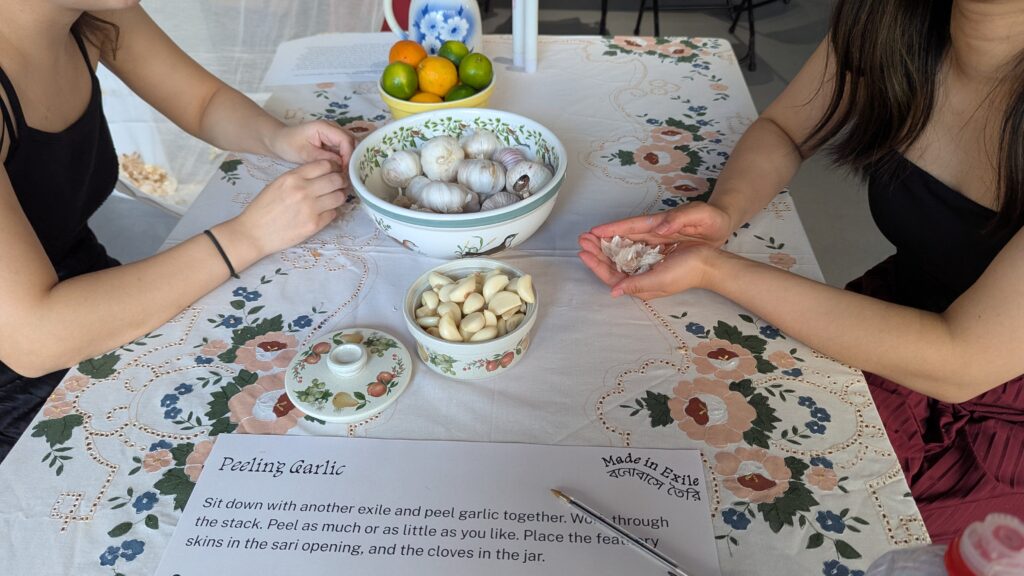
In the dining room was a piece called Peeling Garlic, composed of a bowl of unpeeled garlic, two knives and two chairs arranged around a small table. Visitors were invited to sit across from a friend or stranger and remove the garlic cloves from their wrappings, placing them in a bowl. As the exhibition continued, the silky skins accumulated inside a translucent loop of fabric that formed part of a hyperbolically large sari suspended throughout the gallery. That sari extended into the living room, where it became Stitching Heartbreak.
Throughout the exhibition, I watched people enact moments of reunion through these interventions. One day, three teenage boys wandered into the gallery looking for somewhere to escape the London summer heat. I told them I would give them ice water, but only if they took part in one of the artworks. They glanced over at Stitching Heartbreak and immediately recoiled.
“You’ve never experienced heartbreak?” I asked.
They laughed nervously.
“Uhhhh, we don’t even date.”
“Well… heartbreak doesn’t have to be romantic,” I said, “have you ever missed someone?”
One of the boys paused.
“Wait, actually… my grandad just died.”
Another looked at him in surprise.
“What? My grandad died two years ago.”
By this point they had moved into the dining room and decided to peel garlic instead. I watched the boys, who had entered as a joke, sit around the table and speak about the people in their lives who had died and how they felt about them. Three friends came looking for them, urging them to hurry so they wouldn’t miss the film they were going to see.
“I kind of want to stay,” one of them said.
And they did, for another five minutes.
This returns me to the question I began with. Can performances of revolutionary community practice lead to actual anti-capitalist community building?
For me, tradition should not be evoked for its authenticity, but highlighted as a performance. This performance creates the conditions in which different ways of relating become imaginable and briefly lived. If these ways of relating can counter capitalist norms and logics, then there is the potential for metabolic reunion.
A month ago, almost a year after Made in Exile had closed, I met one of the participants from Stitching Heartbreak. I found myself wondering whether the connection I had witnessed during the exhibition had endured, or whether it had disappeared as soon as people returned to their everyday lives.
“Some of the participants made a WhatsApp group,” she told me. “We’re still in touch.”
F. Zeeshan Choudhury is a socially engaged facilitator, artist and researcher. They advocate for hyperlocal community action, and much of their work takes place in East London. They began their career leading local community art and writing projects that centre anti-capitalist ways of being together. In 2024, they started the Forming New Folklores project, which reimagines traditional art practices as contemporary tools for storytelling in a collaboration between communities in Dhaka, Bangladesh and Bethnal Green, UK. They currently host Wellcome Collection’s series Research & Beyond. They can be found at @fzeeshanchoudhury and fzeeshanchoudhury.com.
Images courtesy of F. Zeeshan Choudhury